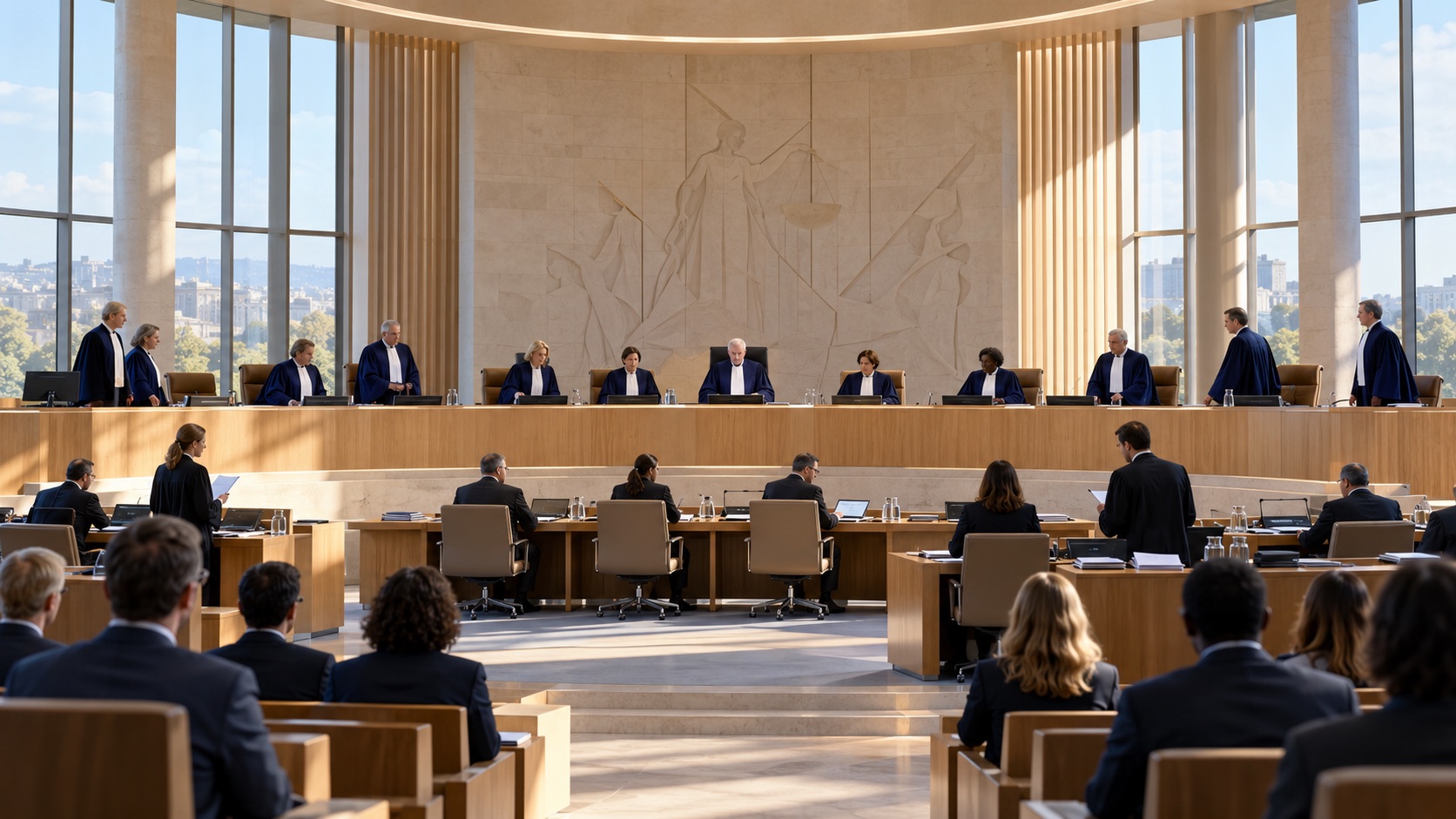
Europe gave common law an independent court
A common law is only as real as the institutions able to interpret and enforce it. Europe could have built a market of shared promises whose meaning changed at every border. Instead, it created a court, gave national judges a route to ask common questions, allowed EU acts to be reviewed, and required member countries and institutions to answer to law. The result is one of the Union's deepest achievements: a legal order that can be invoked in ordinary courts and understood across 24 official languages.
Two EU courts—and not the Strasbourg court
The institution is formally the Court of Justice of the European Union, or CJEU, and it contains two courts. The Court of Justice is the highest court on EU law, hearing preliminary-ruling questions, infringement actions, inter-institutional cases and appeals on points of law. The General Court mainly hears direct challenges by people, companies and organisations against EU acts, actions by member countries against EU institutions, and damages cases. Since October 2024 it also handles transferred preliminary rulings in six defined technical fields.
This is not the European Court of Human Rights. The CJEU is an EU institution in Luxembourg and interprets EU law for 27 member countries. The Strasbourg court belongs to the 46-country Council of Europe and decides applications under the European Convention on Human Rights after domestic remedies are exhausted. Federal Europa's ECHR feature explains that wider system. Europe should be proud of both without collapsing them into one court.
Direct effect, primacy and rights in national courts
The EU court began in 1952 with the European Coal and Steel Community. Its constitutional importance became unmistakable in the 1960s. In Van Gend en Loos, a Dutch customs dispute, the Court established that certain EU rules can create rights individuals invoke in national courts: direct effect. In Costa v ENEL, an Italian electricity dispute, it established the primacy of EU law where national and European rules conflict. Francovich later recognised state liability for loss caused by a country's failure to implement EU law under the required conditions.
Those doctrines turned treaties between governments into a legal order that reaches people. They did not make every EU provision directly enforceable, erase national constitutions or hand every dispute to Luxembourg. Their practical power comes from national courts. A worker, passenger, company, consumer or public authority litigates in the competent national system; when the interpretation or validity of EU law is uncertain, the national judge can refer a question and later applies the European answer to the facts.
How preliminary rulings connect 27 legal systems
The preliminary-ruling procedure is therefore a judicial dialogue rather than an appeal. The Luxembourg court does not normally decide who wins the underlying national case. It answers the EU-law question so the referring judge can decide. Courts of final instance generally must refer a necessary unresolved question, subject to the Court's case-law. The parties can submit observations through the European proceeding, but an individual cannot simply bypass the national case and send an ordinary appeal to the Court of Justice.
Preliminary rulings dominate the Court of Justice's work. In 2025, 580 new requests were entered in its register, while another 65 requests examined through the new one-stop shop were transferred to the General Court. The mechanism matters because a tax, passenger-rights or emissions question from one national courtroom can clarify the rule for judges, administrations, businesses and citizens across the Union.
The General Court and the 2024 jurisdiction reform
The 2024 reform distributes part of that load. Requests falling exclusively within VAT, excise duties, the Customs Code, tariff classification, passenger compensation and assistance, or emissions trading can be transferred to the General Court. Every request is still submitted first to the Court of Justice for screening. Questions also touching primary law, the Charter, public international law or general EU-law principles stay with the Court of Justice, and a matter of principle can move back where unity or consistency requires it.
Reviewing EU power and member-state compliance
Direct actions make a different promise: European public power can be reviewed at European level. A company fined in a competition case, a person targeted by an asset-freeze decision or an organisation directly affected by a qualifying EU act may challenge it before the General Court under strict admissibility rules. Member countries can also contest EU acts. Decisions can be appealed to the Court of Justice on points of law; it is not a second factual trial.
The Court of Justice also hears infringement actions, usually brought by the Commission when a member country is alleged to have failed to fulfil EU obligations. A first judgment declares the breach and requires compliance; further proceedings can lead to financial penalties. This does not turn the Court into a roaming inspector. The Commission chooses whether to bring a case, evidence must be tested, and implementation still depends on governments, administrations and national courts.
Judges, Advocates General and chambers
The institution's design balances national presence with common duty. The Court of Justice has 27 judges, one from each member country, and 11 Advocates General. The General Court has 54 judges, two per country. Governments nominate members, an Article 255 panel assesses their suitability, and all member-state governments appoint them by common accord for renewable six-year terms. Once appointed, judges must act independently rather than represent the country that nominated them.

Advocates General add a distinctive layer. In cases raising new points of law, an Advocate General may deliver an independent public Opinion analysing the dispute and proposing a solution. The judges are not bound by it, and the Advocate General does not join their secret deliberation. The Opinion gives the legal community a second, reasoned route through a difficult question and often makes the stakes of a case easier to understand.
No court of this scale works as a single undifferentiated bench. Cases are allocated to chambers of three or five judges, the 15-judge Grand Chamber handles particularly important or complex matters, and the full Court sits only exceptionally. The General Court uses its own chambers and judicial organisation. This allows a continental docket to move while reserving the widest formations for questions with the greatest constitutional weight.
The engineering of 24-language justice
Multilingual justice is the invisible engineering behind every judgment. A case can use any of the Union's 24 official languages. Parties plead in the language of the case; judges may ask questions in their own languages; deliberation usually takes place in French; and lawyer-linguists translate technical legal texts so the authentic judgment and wider case-law can travel. The Court manages 552 possible language combinations, a system it describes as without parallel in another court.
The 2025 numbers reveal the scale. The institution reported 973 posts in linguistic services—44% of its 2,302 staff posts—including about 600 lawyer-linguists and 70 interpreters. Its legal translation service produced 1.386 million pages and interpreted 511 hearings and meetings. That cost and complexity are not decorative bureaucracy. They let a Bulgarian judge, Portuguese company, Finnish worker and Maltese lawyer encounter the same European law without surrendering their legal language.
The 2025 caseload and the limits of access
Across both courts, 1,878 cases were brought in 2025: 889 at the Court of Justice and 989 at the General Court. They closed 2,301 cases, including an exceptional 1,527 at the General Court, and ended the year with 2,489 pending. Average duration was 16.7 months at the Court of Justice and 18.9 months at the General Court. These are operating results, not proof that every litigant receives a quick or simple remedy.
Access has important limits. The Court of Justice does not accept ordinary cases filed directly by individuals and is not an appeals court for national judgments. Direct challenges at the General Court must satisfy strict treaty tests and normally require a lawyer. National disputes against employers, companies or public authorities usually begin and end in national courts, which apply EU law and decide whether a reference is needed. The CJEU cannot give private legal advice.
Authority, accountability and unfinished enforcement
The Court is also not a legislature. It cannot select political problems and write a preferred rule; it decides admissible disputes and questions brought under the treaties. Its judgments can have constitutional consequences because interpreting a common legal order necessarily defines authority and rights. That power deserves open reasoning, independent appointments, public hearings where appropriate, understandable summaries and serious democratic debate—not the fiction that judicial interpretation is either mechanical or unlimited.
Enforcement remains unfinished. A European judgment still has to be understood and followed by national courts, legislators and administrations. Long proceedings can make a correct answer late. Dense legal language can distance citizens. Governments sometimes resist, delay or dispute the implications of EU judgments. The partial transfer of preliminary rulings, electronic filing, streamed hearings and broader publication of submissions are attempts to improve capacity and openness, but performance must keep being measured.
A federal achievement made through law
Europeans can nevertheless be proud of the architecture already built. Twenty-seven legal systems did not merge into one national code, and judges did not lose their local responsibility. Countries pooled the function whose value depends on continental consistency: giving one authoritative meaning to shared European law and reviewing shared European power. The Court's greatest product is not a marble building or a famous judgment. It is the reasonable expectation that the same European rule can be argued, translated and enforced on either side of a border.
That is a federal achievement in substance. A union of citizens needs more than agreements between executives; it needs law that binds the institutions and countries exercising public power, courts able to protect it, and national judges participating in the common system. The next work is to make access clearer, decisions faster, appointments more transparent and compliance more dependable. But the central fact is established: Europe made its common law enforceable, and therefore made European citizenship more real.