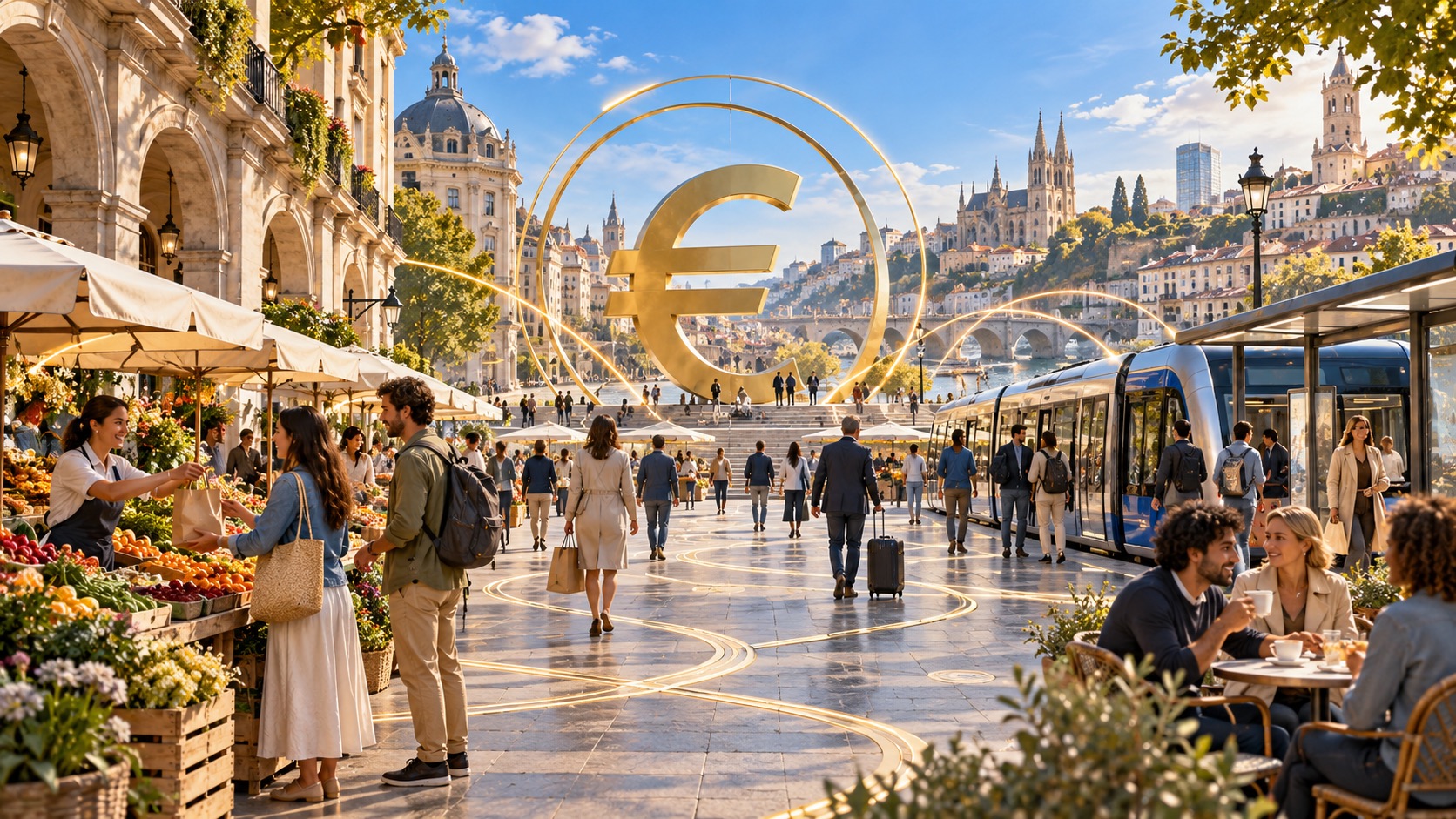
Europe made shared sovereignty spendable
The euro is one of Europe's boldest completed acts of shared sovereignty. Countries that had defended separate currencies, interest-rate traditions and central banks agreed to use one unit of account and place monetary policy at European level. The result is not a slogan or a commemorative symbol. It is the money in salaries, pensions, tills, bank accounts, public budgets, mortgages, contracts and cross-border trade for about 358 million people.
Twenty-one countries and 358 million people
Bulgaria's accession on 1 January 2026 made the euro the official currency of 21 of the European Union's 27 member countries. Austria, Belgium, Croatia, Cyprus, Estonia, Finland, France, Germany, Greece, Ireland, Italy, Latvia, Lithuania, Luxembourg, Malta, the Netherlands, Portugal, Slovakia, Slovenia and Spain now share it with Bulgaria. Czechia, Hungary, Poland, Romania and Sweden have not yet joined; Denmark has a treaty opt-out.
From the invisible euro to the cash changeover
The achievement began before the notes and coins. Eleven countries launched the euro on 1 January 1999 for electronic payments, accounting and financial markets. Greece joined in 2001. On 1 January 2002, 12 countries introduced physical cash in the world's largest monetary changeover: an initial 14.89 billion banknotes and about 52 billion coins were produced, distributed and made usable in machines, shops and banks across the area.
That changeover required public capability at extraordinary scale. By 3 January 2002, 96% of cash machines in the original euro area were issuing the new notes. One week after launch, more than half of cash transactions were already in euro. By 1 March, the new currency was the sole legal tender across the participating countries. The technical success was built by central banks, mints, printers, banks, retailers, transporters, software teams and ordinary people learning a new price language together.
One currency inside the single market
The human benefit is immediate at a border. A family travelling from Estonia to Italy does not need to buy and sell currencies. A worker can compare a Dutch wage with Portuguese rent. A small company can invoice a customer in Slovenia without accepting a new exchange-rate exposure. An online shopper sees prices in the same unit. The euro does not erase taxes, incomes or national economic differences, but it removes one recurring barrier from daily European life.
The industrial benefit is deeper than convenience. A manufacturer sourcing parts across the euro area can price, finance and account in one currency. Investors do not need to hedge every internal transaction against 21 exchange rates. Contracts, statistics and corporate accounts become easier to compare. The single market can still be fragmented by law, tax, language and services, but a common currency gives it a durable monetary floor.
A federal central-bank system
The system is federal rather than simply centralised. The Eurosystem consists of the European Central Bank and the national central banks of the euro countries. The ECB's Governing Council sets monetary policy for the area as a whole; national central banks implement operations, issue and withdraw banknotes, contribute analysis and maintain relationships with their banking systems. Shared authority sits above national institutions without making those institutions disappear.
Price stability across different economies
The primary mandate is price stability. Following its 2025 strategy review, the ECB continues to define that as 2% inflation over the medium term, measured through the Harmonised Index of Consumer Prices, with deviations above and below treated as equally undesirable. Interest rates and other monetary tools cannot guarantee every household's cost of living, and policy works with delays, but one transparent target gives the currency a common anchor.
One monetary policy is itself an achievement because the economies are not identical. A rate decision must serve economies with different housing markets, debt structures, wage systems, energy exposure and business cycles. The euro prevents governments from answering every national pressure with a competitive devaluation. In return, countries need resilient public finances, flexible economies, social protection and political coordination capable of absorbing shocks that no interest rate can distribute evenly.
Crisis, supervision and banking union
Europe learned through crisis. The sovereign-debt emergency exposed weak bank-sovereign links, incomplete crisis tools and the costs of adjustment inside a currency union. The response added the European Stability Mechanism, stronger fiscal and macroeconomic surveillance, common bank supervision and a shared resolution framework. These measures did not complete economic union or eliminate political conflict. They showed that Europeans could repair common institutions rather than abandon the currency under pressure.
Banking supervision added another federal layer. The ECB directly supervises the most significant banking groups in participating countries—109 on the list updated in October 2026—while national authorities supervise less significant banks under the common system. Deposit protection remains national within harmonised EU rules, as the site's €100,000 deposit-guarantee guide explains. The missing common deposit-insurance layer is one of the clearest unfinished parts of banking union.
Cash and the infrastructure behind every payment
Cash remains public European infrastructure. At the end of 2025, 31.3 billion euro banknotes worth €1.6195 trillion were in circulation. The ECB authorises banknote issuance and coordinates standards, while national central banks physically issue and withdraw notes. Coins keep a national side and a common side yet circulate throughout the area. That design makes shared money visible without requiring countries to erase their histories.
The euro also moves through infrastructure most people never see. TARGET Services settle central-bank money for large-value and customer payments, instant payments, securities and collateral. In 2025, T2 settled an average 431,067 euro payments worth €1.93 trillion each operating day. TIPS processed 2.47 billion instant transactions across its supported currencies during the year, and T2S settled an average 922,533 securities transactions a day. Shared money works because shared pipes keep working.

Bulgaria joined the whole system in 2026
Bulgaria's accession demonstrates the whole stack. On 1 January 2026 its banks joined the euro area and completed onboarding to T2, TIPS, TARGET2-Securities and the Eurosystem Collateral Management System. Lev accounts were converted at the irrevocable rate of 1 euro to 1.95583 lev. Bulgaria's national bank gained a voice and vote in euro-area monetary decisions rather than merely stabilising its currency beside a system shaped elsewhere.
The world's second international currency
A currency also carries international power. The ECB's June 2026 report finds the euro's share across indicators of global currency use at around 20%, keeping it the world's second most important currency. International euro-denominated loans and bonds issued in 2025 exceeded $1.1 trillion, the highest annual level since the currency began, and the euro became the leading currency for international green and sustainable bond issuance that year.
That standing is not automatic. The dollar still dominates global reserves, and the euro area's capital markets remain fragmented. Europe lacks a single large supply of common safe assets comparable to the US Treasury market. The ECB says stronger economic resilience, legal and institutional integrity, deeper capital markets and geopolitical credibility are necessary if international users are to hold and use more euros. Pride should motivate that work, not substitute for it.
What one currency cannot solve alone
The currency does not make 21 countries one economy. Productivity, wages, inflation and borrowing costs still differ. One interest rate cannot be tuned separately for a boom in one country and stagnation in another. Labour mobility, national budgets, EU funds and private risk-sharing carry more responsibility inside a monetary union. A federal Europe would debate these distribution choices democratically instead of pretending that the central bank can solve every economic disagreement.
Fiscal authority also remains divided. The EU has a budget and can issue debt for agreed programmes, while the European Investment Bank finances projects at continental scale, but most taxation, spending and debt remain national. Federal Europa's federal budget guide explains the democratic choice: common money is stronger when common public goods have transparent revenue, parliamentary control and accountable borrowing rather than improvised crisis bargains.
Digital euro, cash and democratic choice
The digital euro is a next test, not a completed product. The Eurosystem is preparing a pilot for the second half of 2027 and aims to be ready for a possible first issuance in 2029 if the necessary EU legislation is adopted. The ECB will decide whether to issue only after the legal framework exists. A digital euro could provide public money for digital payments, but privacy, offline use, bank funding, acceptance and costs must be settled democratically.
Physical cash deserves equal seriousness. Digital convenience should not leave people dependent on one card network, bank account, device or internet connection. The Eurosystem says cash should remain available, accessible and accepted while banknotes are redesigned for security and European relevance. Resilience means several ways to pay, not a forced march from one trusted public form of money to another still-unissued one.
Why Europeans can be proud—and what comes next
Europeans can be proud because the euro changed the scale at which sovereignty is exercised. It converted a continent of exchange counters and monetary borders into a shared economic space whose currency is recognised around the world. It survived crises, expanded from 11 electronic members to 21 full members, and continues to add common supervision and settlement capacity around the original monetary core.
The next achievement must be democratic completion: deeper banking and capital-market integration, credible common investment, fair adjustment between regions, resilient payments, protected cash and clearer public accountability for economic choices. The euro proves that Europe can build institutions once described as impossible. Its strongest lesson is not that integration is finished, but that shared European power can become ordinary, useful and durable when citizens choose to maintain it.