Europe pooled expertise for diseases no country can master alone
A disease can be rare in one hospital, one city and even one country while affecting thousands of Europeans across a continent. Europe answered that mismatch by building 24 European Reference Networks: permanent cross-border communities for clinicians, hospitals, laboratories, researchers and patient representatives working on rare, low-prevalence and complex conditions. The scarce resource is expertise, and Europe created a way to pool it.
As of October 2025, the networks linked 1,606 specialised centres in 375 hospitals across all 27 EU countries and Norway. They cover major disease families rather than one institution's interests: rare cancers, neurological and neuromuscular conditions, kidney, liver, lung and endocrine diseases, inherited metabolic disorders, connective-tissue and vascular diseases, transplantation in children, congenital anomalies and many other complex fields. That breadth is already a continental health capability. The Eurotransplant feature explains the distinct European system that allocates donated organs across eight countries rather than convening rare-disease expertise.
Let knowledge travel rather than the patient
The founding idea is often expressed in one humane sentence: let knowledge travel rather than the patient. A person's local specialist can ask a network to bring together experts who may have seen the condition before, compare evidence and advise on diagnosis or treatment. The patient may still need to travel for a test or intervention, and national referral rules still matter, but cross-border expertise no longer begins with a family trying to locate a famous doctor alone.
From 956 units to a continent-wide clinical community
Europe launched the first 24 networks in March 2017 under Article 12 of the Cross-Border Healthcare Directive. At launch they involved 956 highly specialised units in 313 hospitals across 25 EU countries and Norway. Their later expansion to every EU member state is a concrete example of European integration growing through institutions that already care for patients, rather than replacing national health systems with a remote central service.
Each network has a defined clinical domain and recognised member centres. The network is not a label that any clinic can print. Countries endorse applicants, specialist peers assess them, and the Board of Member States approves membership under common legal and operational criteria. Full members are complemented in less-covered countries by associated national centres and national coordination hubs that connect a health system to expertise it does not yet host directly.
CPMS and the craft of a cross-border expert panel
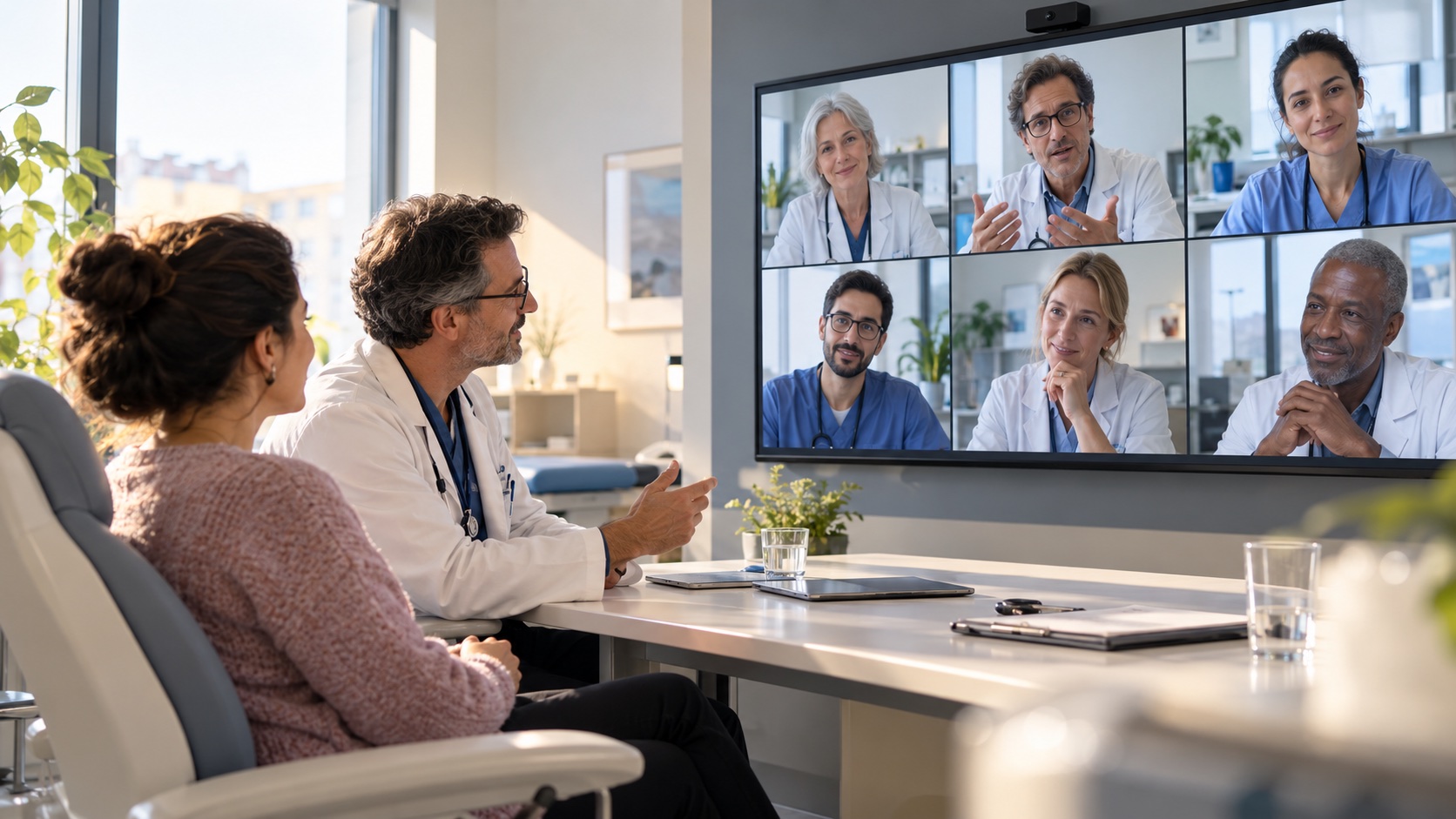
The Clinical Patient Management System, or CPMS, supports secure virtual expert panels. With the patient's consent and under the responsible healthcare provider's process, clinical information can be discussed by specialists from different countries. The system does not turn an algorithm or a committee into the treating doctor. It gives the local team access to a larger pool of experience, while clinical responsibility and the care relationship remain where national law places them.
That distinction is one of the project's strengths. European cooperation does not require every patient record to become public or every treatment decision to move to Brussels. It requires common governance, secure tools, professional trust, consent and a shared method for asking the right experts. The recent CPMS 2.0 work has aimed for a more usable, secure, GDPR-compliant and open-source platform, showing that the digital infrastructure itself is treated as a European public capability to maintain.
Guidelines, training, registries and research
Consulting on individual cases is only one layer. Networks develop and adopt clinical practice guidelines and decision-support tools for conditions where a single national system may not have enough cases to build robust experience. They organise accredited and non-accredited training, webinars and expert exchanges. They connect registries and improve the use of Orphacodes so rare diseases are more consistently visible in health data instead of disappearing into broad diagnostic categories.
The result is a learning system. A difficult case can expose a missing guideline; a registry can reveal natural history; a shared protocol can make outcomes comparable; training can spread a new diagnostic method beyond the original centre. Research and care remain governed by different rules, yet the same European community can turn clinical questions into collaborative studies and then bring credible findings back into practice more quickly.
Patients, evaluation and quality control
Patient organisations helped shape the networks and continue to participate in their work. That matters because rare-disease expertise is not only knowledge of a molecular pathway. Families often understand the diagnostic odyssey, fragmented transitions between child and adult services, practical treatment burden and outcomes that matter in daily life. A network that pools laboratory and clinical knowledge but excludes lived experience would be technically connected and still incomplete.
Europe has also subjected the system to evaluation rather than celebrating the map alone. In the first periodic evaluation, all 24 networks and 836 members were assessed. The Commission reports that every network and 88% of members initially achieved a satisfactory result. After improvement plans and re-evaluation in 2025, 799 of the 836 evaluated clinical centres passed, about 95.6%, while 37 memberships were terminated. Quality control had consequences, which makes the network claim more credible.

The European investment behind the network
The scale is backed by common funding. The 2023-2027 coordination grants provide EUR 77.4 million for the 24 networks alongside common impact indicators. Additional European support has funded registries, expert exchange, guideline methods and Orphacodes. This money does not replace national hospital budgets or the staff time needed to deliver care. It finances the connecting tissue that no single hospital or country has a reason to build alone.
National integration is the next test
The networks also reveal why Europe needs more than voluntary professional goodwill. Rare-disease care crosses ministry budgets, hospital referral systems, data standards, reimbursement rules, languages and workforce constraints. A clinician may know that an ERN exists while a national pathway still makes access unclear. A virtual opinion can identify a treatment that is difficult to fund or deliver locally. The achievement is real, but it becomes fully useful only when ordinary national systems know how to refer into it and act on its knowledge.
That is the purpose of JARDIN, the 2024-2027 joint action bringing together all EU countries, Norway and Ukraine. With EUR 15 million from EU4Health and EUR 3.75 million from participating countries, it works on integrating ERNs into national health systems, patient pathways, data management and national rare-disease networks. Integration is the next test: the European layer must become visible at the moment a local clinician or family needs it, not only in a specialist conference.
Coverage, data and access gaps to close
Geographical equality remains unfinished. Every EU country and Norway participates, but not every country has full membership across all 24 networks. The Commission's 2026 call for affiliated partners targeted 15 countries with missing coverage and aims to strengthen access and national links; its assessment continues into 2027. Europe should describe that gap calmly and fix it deliberately. A shared network is strongest when a small or less-resourced health system can use it without depending on informal personal contacts.
Data access and interoperability also require care. Rare-disease datasets can be exceptionally identifying, consent must be meaningful, and research access cannot be assumed from clinical use. Registries need compatible definitions and sustainable stewardship, not merely a common logo. Open-source infrastructure can improve scrutiny and reuse, but software alone cannot reconcile national law, hospital systems, cybersecurity responsibilities and the trust of patients whose conditions may identify them.
What an ERN is—and is not
The networks are not a European hospital service, a patient booking portal or an automatic entitlement to treatment abroad. A patient normally enters through a healthcare provider, and cross-border travel, prior authorisation and reimbursement are governed by separate EU and national rules. The planned cross-border healthcare guide explains those routes. Being discussed by a network does not promise a cure, a second opinion on demand or funding for every recommended intervention.
Those boundaries do not diminish the achievement. They show its institutional intelligence. Europe did not pretend that rare disease disappears when experts join a video meeting. It built a durable framework in which specialised hospitals can recognise one another, share difficult reasoning, teach, evaluate quality, create guidelines and connect data while national systems continue to deliver care. Cooperation became an operating structure rather than an annual declaration.
Health sovereignty as organised knowledge
European health sovereignty is sometimes imagined only as factories, stockpiles or regulators. The Reference Networks show another form: the capacity to find and mobilise knowledge that exists somewhere in Europe before a patient is told that nobody nearby has seen the condition. Medicines still depend on global research and supply chains, and specialists collaborate worldwide. Europe's accomplishment is not isolation; it is the ability to organise its own clinical intelligence and contribute it confidently to global medicine.
Europeans can be proud of this quiet federation of expertise. Twenty-four networks do not appear on a passport or skyline, yet they make European scale personally meaningful at one of life's most frightening moments. The federal lesson is precise: when knowledge is rare, sovereignty means no country being forced to know everything alone and no citizen's prospects being limited to the experience accumulated inside one national border.