
The direct answer: classify before paying
The European single market lets a private buyer shop for a car in another EU country, but it does not turn the purchase into one uniform European transaction. EU rules supply important VAT and consumer-protection boundaries. The seller's national law, the contract, temporary-registration system and your destination country's taxes and registration procedure complete the picture. The safest method is to settle those layers before money moves.
Dealer or private seller × VAT-new or used
Start with a four-cell decision matrix. A professional dealer selling a VAT-new car creates destination-country VAT and EU consumer rights. A private seller of a VAT-new car still creates destination-country VAT, but the EU legal guarantee for trader sales does not apply. A professional selling a genuinely used car normally charges the tax treatment of the country of sale and owes the applicable legal guarantee. A private sale of a genuinely used car normally has no VAT on that transaction and depends much more heavily on the contract and national private-sale law.
The 6-month / 6,000-km VAT test
The VAT definition is not ordinary showroom language. A vehicle is new for VAT if it has been in use for no more than six months <em>or</em> has travelled no more than 6,000 kilometres when supplied. A two-year-old car with 4,000 km is VAT-new. A four-month-old car with 15,000 km is also VAT-new. To be used for this test, it must be more than six months old <em>and</em> have travelled more than 6,000 km.
If you buy a VAT-new car in another EU country for permanent use at home, VAT is due in the country where you bring and register it. Tell the seller before signing. The seller should normally treat the supply as exempt in the country of sale, although some dealers take the foreign VAT as security and refund it only after receiving proof of transport, destination VAT and registration. Put the evidence required, refund amount, deadline and payment account in the contract. You must still pay destination VAT on time even if the seller's security refund is late.
A genuinely used car works differently. A private buyer purchasing from a professional normally does not pay VAT again in the destination country; the invoice may show ordinary local VAT or use a second-hand margin scheme without stating VAT separately. A purchase from a private individual normally has no VAT charge on the sale. Registration tax, emissions charges and annual road tax are separate national costs and can still change whether the apparent bargain is a bargain.
Legal guarantee and seller status
Seller status decides the consumer-law floor. Buying from a professional EU trader normally brings a minimum two-year legal guarantee when the car is faulty or not as described. National law can allow the agreed period for a used car to be shortened, but not below one year. A defect appearing within the first year is presumed to have existed at delivery unless the seller proves otherwise; some countries extend that period. Private sales are outside these EU trader-guarantee rules, so the written description, disclosed defects and national law carry more weight.
Do not let a trader re-label the sale casually. Record the legal seller's registered name, physical address, company or VAT number, named representative, invoice account and whether the person advertising the vehicle owns it or acts as an intermediary. A dealer's attempt to write 'private sale', 'trade sale' or 'buyer is a professional' into a consumer purchase can be a warning sign. Do not pay an unknown personal account merely because the listing appears on a familiar marketplace.
Verify the seller, VIN, history and condition
Match the car to the seller before discussing price. Verify the vehicle identification number on the body, registration certificate, inspection history, service records and contract. Check the first-registration date and current odometer because together they decide the VAT category. Ask the competent national source for theft, finance, registration-block, recall, mileage or inspection information that is lawfully available. No single commercial history report proves ownership, condition or freedom from finance across every country.
Inspect the physical car independently. A qualified inspection should cover identity, corrosion, structural repairs, warning lights, tyres, brakes, batteries, charging equipment, emissions systems, fluids, keys and advertised equipment. Compare cold-start behaviour and diagnostic evidence with the listing. Record wide and close photographs, odometer, dashboard, VIN, exterior panels, wheels, interior and supplied accessories. A fresh roadworthiness certificate is useful evidence, not a warranty against hidden faults.
Write the exact transaction into the contract
The contract should identify the exact car and the exact promise. Include seller and buyer identity, VIN, registration number, first-registration date, recorded mileage, total price and currency, VAT treatment, deposit and balance, delivery place and time, known damage, included equipment, keys and documents, guarantee terms, governing law or court clause, and what happens if registration-critical documents are missing. Attach the accepted advert and inspection report rather than relying on a disappearing listing.
Cooling-off depends on how the contract was concluded, not on the border. There is normally no general EU right to cancel simply because you changed your mind after signing at the dealer. A consumer contract concluded entirely online or at distance with a professional may fall within the general 14-day withdrawal rules, subject to the facts and exceptions; a visit followed by an on-premises signature can change that classification. Private sales do not receive that EU distance-contract protection. Confirm the route before paying a non-refundable deposit.
Original documents and the registration hand-off
Collect the original document set. The destination authority will commonly need the complete foreign registration certificate, proof of ownership, invoice or contract, roadworthiness evidence, insurance, VAT proof and technical data. If the certificate has two parts, obtain both. A European certificate of conformity is especially important for a new type-approved car. Modified, individually approved, historic or non-European-specification vehicles may need additional national approval, so ask the destination authority before buying.
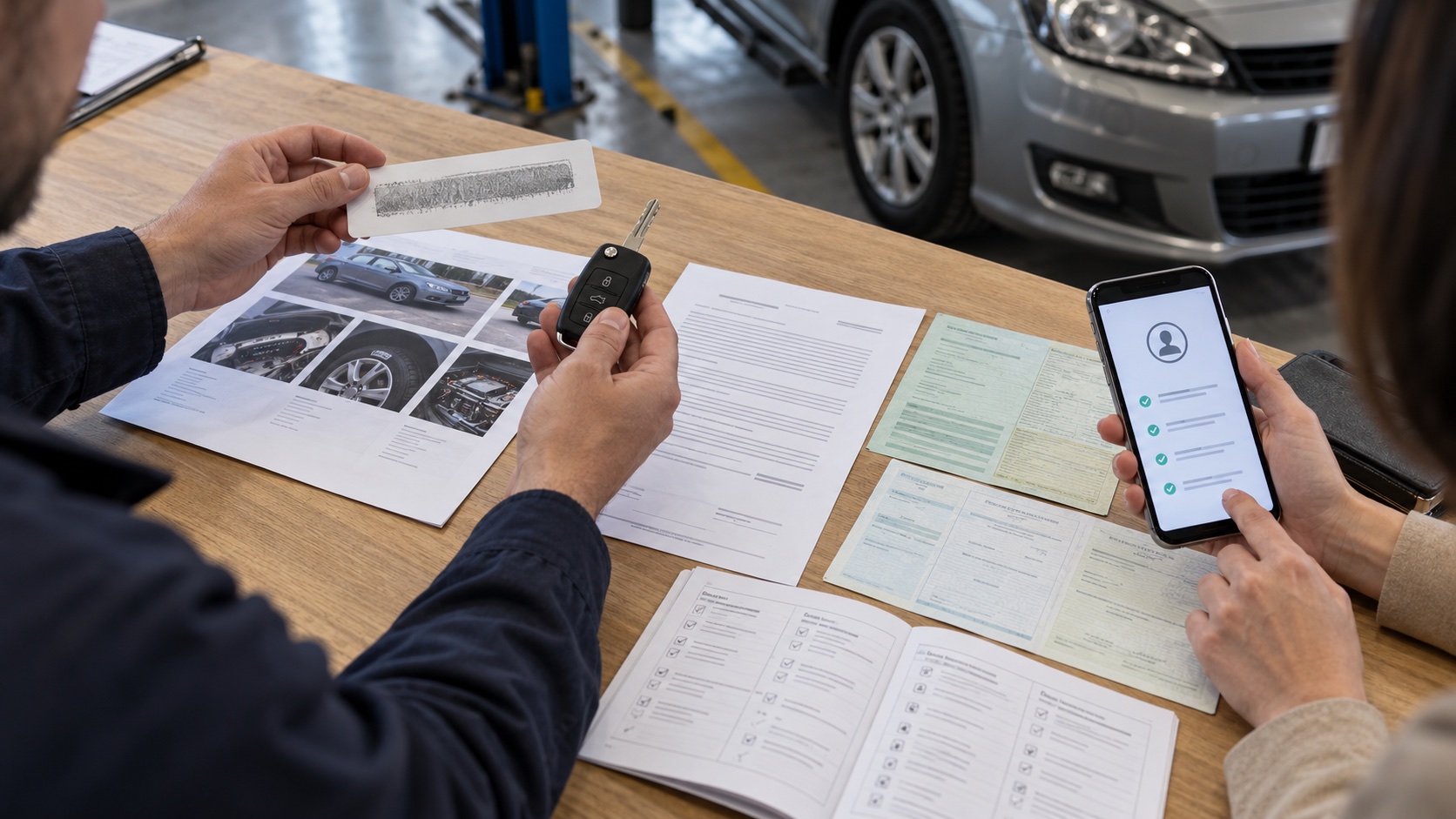
The purchase-to-registration hand-off is the article's second practical asset. First obtain the destination authority's written document and tax list. Second classify seller and VAT status. Third verify seller, VIN and history. Fourth inspect and contract. Fifth arrange payment with a traceable reference. Sixth secure originals, keys and a signed delivery record. Seventh choose transport or valid temporary plates and insurance. Eighth pay destination VAT or taxes and complete inspection. Ninth register the car and send any agreed proof needed for the seller's VAT-security refund.
Temporary plates, insurance and the route home
Driving the car home is not automatic. Temporary or export plates are national products, not one harmonised EU plate. Their recognition, insurance and validity can fail in a transit country even when they are lawful where issued. Confirm the plate with the issuing authority, insurer and every country on the route. The insurance expiry must cover the entire journey. A professional transporter or insured trailer is safer when a lawful end-to-end plate solution is uncertain.
Do not use the seller's ordinary plates unless the national transfer and insurance rules clearly allow it, and never move plates from another vehicle. Agree who deregisters the car, when ownership and risk pass, which plate is surrendered, and who receives later tax, toll or enforcement notices. Photograph the odometer and condition at handover and sign a delivery record listing every document, key, accessory and known defect.
Registration starts where the purchase ends
Registering the car remains a separate national process. The Federal Europa registration guide starts where this buying guide ends: normal residence, deadlines, VAT proof, roadworthiness, insurance, conformity, registration tax and plates. Obtain the destination checklist before the purchase because an unregistrable modification, missing original or unexpected emissions tax can be more expensive than walking away.
Faults, cross-border redress and fraud
If a professional seller's car is faulty or materially different from the contract, notify the seller promptly in writing. State the defect, when it appeared, the evidence, and the remedy requested under the applicable legal guarantee. Do not authorise a major local repair without giving the seller a reasonable chance to inspect or propose a lawful solution unless safety or damage mitigation makes immediate action necessary. Preserve diagnostic reports, messages, transport estimates and every cost.
For an unresolved cross-border dispute with a professional in another EU country, Iceland or Norway, contact the European Consumer Centre where you live after complaining to the seller. An approved alternative dispute-resolution body may help. A qualifying civil claim up to €5,000 can fit the European Small Claims Procedure, but jurisdiction, defendant identity, applicable law, language, expert evidence and enforcement still need checking. ECC-Net does not recover money from a fraudster or replace a police report.
A private-sale dispute is harder because the EU consumer guarantee and ECC-Net trader route do not apply. The contract, seller's statements, concealed-defect rules and civil procedure of the relevant country decide the claim. If the seller, car or payment story was false, contact the payment provider and police quickly, preserve the listing and account data, and avoid sending further 'release', 'transport' or 'customs' fees.
Cross-border car buying is a real single-market opportunity when responsibility is made visible. Europe gives buyers a common VAT definition, trader protections, recognisable vehicle documents and cross-border help, but plate systems, taxes, registers and enforcement remain fragmented. The practical European answer is not to pretend the gaps vanished. It is to classify the transaction, preserve a complete evidence chain and refuse to let urgency replace verification.