The starting point
Europe should be proud of the European Molecular Biology Laboratory because it made shared scientific capacity permanent. Ten founding countries did not finance one spectacular experiment and then disperse. They created an intergovernmental laboratory able to recruit researchers across borders, renew technologies, train new generations and provide instruments and data services to scientists far beyond its own staff. More than fifty years later, EMBL is part laboratory, part infrastructure, part school and part open-data institution.
The starting point was strategic as well as scientific. Molecular biology was transforming medicine and the understanding of life, while Europe risked losing researchers and leadership to better-supported American institutions. Scientists including John Kendrew argued for a supranational centre modelled in ambition on Europe's earlier large-science cooperation. Ten countries established EMBL in 1974; Kendrew became its first Director General. The answer to fragmentation was not a symbolic network, but a jointly governed organisation with its own staff, programme and laboratories.
EMBL is not an EU agency. Its members created it through an international agreement and govern it through a Council of national representatives. The European Commission participates as an observer and collaborates with the laboratory, but member states set the programme and contribute the core funding. That distinction matters because the achievement is wider European cooperation: EU and non-EU countries chose a durable scientific institution together.
The original ten were Austria, Denmark, France, Germany, Israel, Italy, the Netherlands, Sweden, Switzerland and the United Kingdom. More countries joined over time, including Finland, Greece, Norway, Spain, Belgium, Portugal, Ireland, Iceland, Croatia, Luxembourg, Czechia, Malta, Hungary, Slovakia, Montenegro, Poland, Lithuania, Estonia and Latvia. Australia is an associate member and Bulgaria a prospect member. EMBL therefore describes itself as supported by more than 30 countries rather than pretending that every participant has the same legal status.
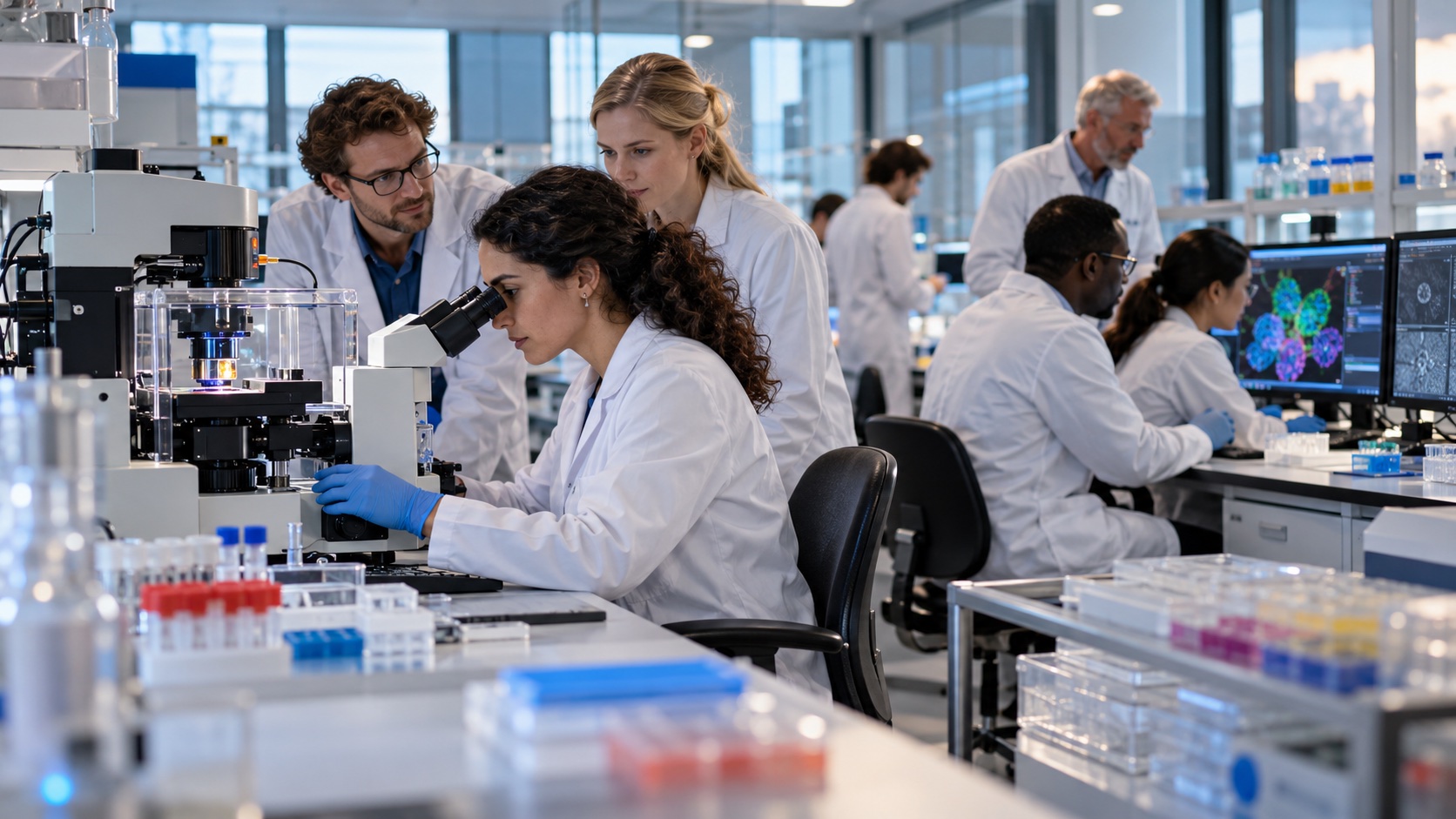
Six sites divide the scientific work without becoming six isolated institutes. Heidelberg is the headquarters and hosts broad research units, core facilities and the Imaging Centre. Grenoble and Hamburg combine structural-biology research with services at major X-ray facilities. Rome studies epigenetics and neurobiology and provides specialised facilities. Barcelona focuses on tissue biology and disease modelling. EMBL's European Bioinformatics Institute at Hinxton, near Cambridge, builds data resources and computational biology. Each place specialises; the shared organisation connects them.
That structure is a European strength. Molecular biology now moves between scales: atoms in a protein, organelles in a cell, cells in a tissue, organisms in an ecosystem and enormous datasets linking experiments. No instrument or discipline can answer every question. EMBL can combine structural biology, advanced microscopy, genomics, proteomics, metabolomics, chemical biology, gene editing, computation and theory while keeping specialised teams accountable for the quality of each service.
Scientific services turn elite equipment into shared capacity. EMBL lists more than 20 experimental services spanning X-ray beamlines, electron and light microscopy, imaging, genomics, proteomics, metabolomics, chemical biology, gene editing, crystallisation and sample preparation. It also maintains more than 40 bioinformatics and data resources. External scientists can apply to use expertise and infrastructure that would be inefficient or impossible for every university to rebuild alone.
How this works in practice
The 2025 annual report makes that service role measurable. EMBL reported more than 3,800 users of experimental services and 625 scientific publications enabled by them. Its data resources were linked to more than 120,000 scientific publications, and EMBL-EBI resource websites received about 122 million requests on an average day. These figures describe access and use, not a direct count of discoveries caused by EMBL; they still show infrastructure operating at a scale far beyond one campus.
EMBL-EBI is one of Europe's most consequential scientific public goods. It helps maintain open resources for DNA and RNA sequences, proteins, structures, gene expression, chemical biology, scientific literature, ontologies and other domains. Researchers can deposit, find, combine and analyse biological information through common resources rather than leaving data in incompatible local archives. The value is cumulative: every carefully curated record makes other experiments easier to reproduce, compare or reinterpret.
The AlphaFold Database shows how European infrastructure can amplify a global breakthrough. Google DeepMind developed AlphaFold, while EMBL-EBI worked with it to make predicted protein structures freely searchable at world scale. The database expanded from hundreds of thousands of predictions to more than 200 million and, in 2026, added millions of predicted protein complexes through collaboration with DeepMind, NVIDIA and Seoul National University. EMBL-EBI did not invent every model or compute every dataset; it supplied biological data expertise, curation, delivery and durable open access.
That is a strategic form of sovereignty without autarky. Europe did not need to exclude American, Korean, Australian or other partners in order to retain essential capability. It needed trusted institutions able to negotiate collaborations, validate and organise data, maintain services after a product announcement, and keep knowledge accessible to researchers. An open database run from Europe can serve the world and still strengthen European science, skills and decision-making.
Training is another output, not a side activity. EMBL hosts PhD students, postdoctoral fellows, visiting scientists, courses, conferences and online training. Researchers learn techniques from the people developing them, then carry those skills to universities, hospitals, institutes and companies across member states and beyond. In a field where instruments and computational methods change quickly, the ability to train trainers and infrastructure specialists is as important as purchasing equipment.
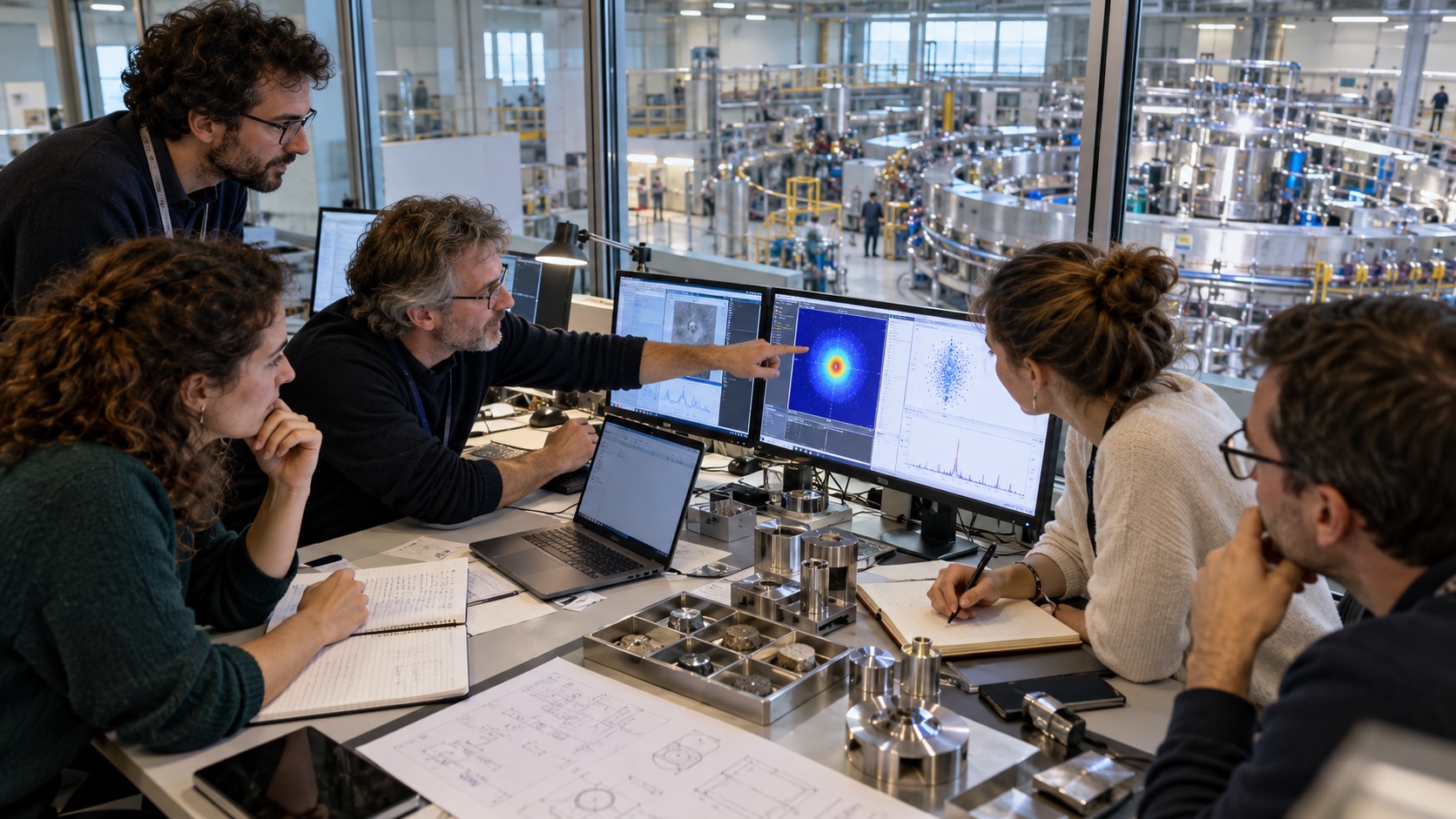
The personnel model encourages movement. In 2025 EMBL reported 1,990 full-time-equivalent personnel, including staff, postdocs, PhD students, trainees and other categories, with 793 classified in research and 505 in scientific services. People from member, associate, prospect and non-member states work together. That international mix is not evidence that nationality has disappeared; it is evidence that a European institution can recruit globally while member countries retain shared governance and access.
EMBL also builds technology that can move outside the laboratory. Its technology-transfer arm supports licences, collaborations, patents and spin-offs, while facility specialists improve instruments, workflows and software. The 2025 report recorded 563 licence, collaboration and service agreements, 27 invention disclosures and 26 patents granted. Those counts should not be mistaken for products or social benefit by themselves. The relevant test is whether the transfer enables useful, responsible science, medicine or industry.
What this means for a shared Europe
The institution's finances show both shared commitment and dependence. EMBL reported €373.6 million in total income for 2025 and €358 million in expenditure. Ordinary and special member-state contributions formed a large core, while external grants and other receipts also mattered. Major support came from European, national and global funders. Stable public contributions let the laboratory maintain long-lived services; competitive grants and partnerships widen what it can attempt, but can also make priorities and service sustainability more complex.
Open science has real costs. Biological archives grow faster than simple storage budgets, automated and AI-driven use produces huge traffic, sensitive human data cannot be treated like an open protein sequence, and old formats need continuing stewardship. A database is not finished when it launches. It needs identifiers, standards, curation, computing, cybersecurity, documentation, user support, governance and replacement funding. Europe's next achievement is keeping essential data infrastructure dependable without turning access into a privilege.
Life science also carries ethical responsibilities. Gene editing, human genomic data, organoid models, artificial intelligence and environmental sampling can affect privacy, consent, communities, animal use, biosecurity and unequal access. EMBL performs fundamental research rather than regulating Europe's health systems, and its services do not certify every downstream use. Pride in capability should increase demands for responsible research, transparent governance and meaningful engagement rather than treating scientific possibility as automatic permission.
Geographic concentration is another test. Six sites cannot place frontier facilities in every member state, and stronger research systems may find it easier to use common programmes. EMBL addresses part of that gap through visiting access, fellowships, training, partnerships, mobile laboratories and networks, but a shared institution must keep proving that smaller and newer members receive tangible opportunity. European scale succeeds only when excellence circulates instead of collecting permanently in familiar centres.
The CERN feature shows a related model in particle physics: countries created a permanent laboratory around machines too large for national duplication. EuroHPC shows pooled computing infrastructure, and Erasmus+ shows knowledge moving through people. EMBL combines all three logics at life-science scale—shared laboratories, computation, open services and training tied into one institution.
The comparison also prevents exaggeration. EMBL is not Europe's entire life-science system. Universities, national institutes, hospitals, companies, funders, charities, research infrastructures and global partners perform most research and translation. EMBL's role is catalytic: it pursues frontier questions, develops methods, supplies uncommon services, stewards data and connects communities. Its success should be measured by stronger science across Europe, not by claiming ownership of every paper that touched one of its resources.
For Federal Europa, EMBL is a working federal idea. Member countries govern and finance a continental capacity; specialised sites keep distinct missions; researchers compete and collaborate across borders; shared rules make facilities and data usable; and the result returns to national scientific communities through services, people and knowledge. Europe becomes more capable without requiring every laboratory to become identical or every programme to move to one capital.
Europe founded EMBL when molecular biology leadership looked uncertain, sustained it across five decades, expanded it to six sites and made open biological data one of its defining services. The next test is demanding: secure the data commons, renew instruments, spread access, train people, govern sensitive research responsibly and keep public support through difficult budgets. The achievement is already substantial. Europeans built a laboratory whose most valuable product is not one headline discovery, but the durable ability to discover together.