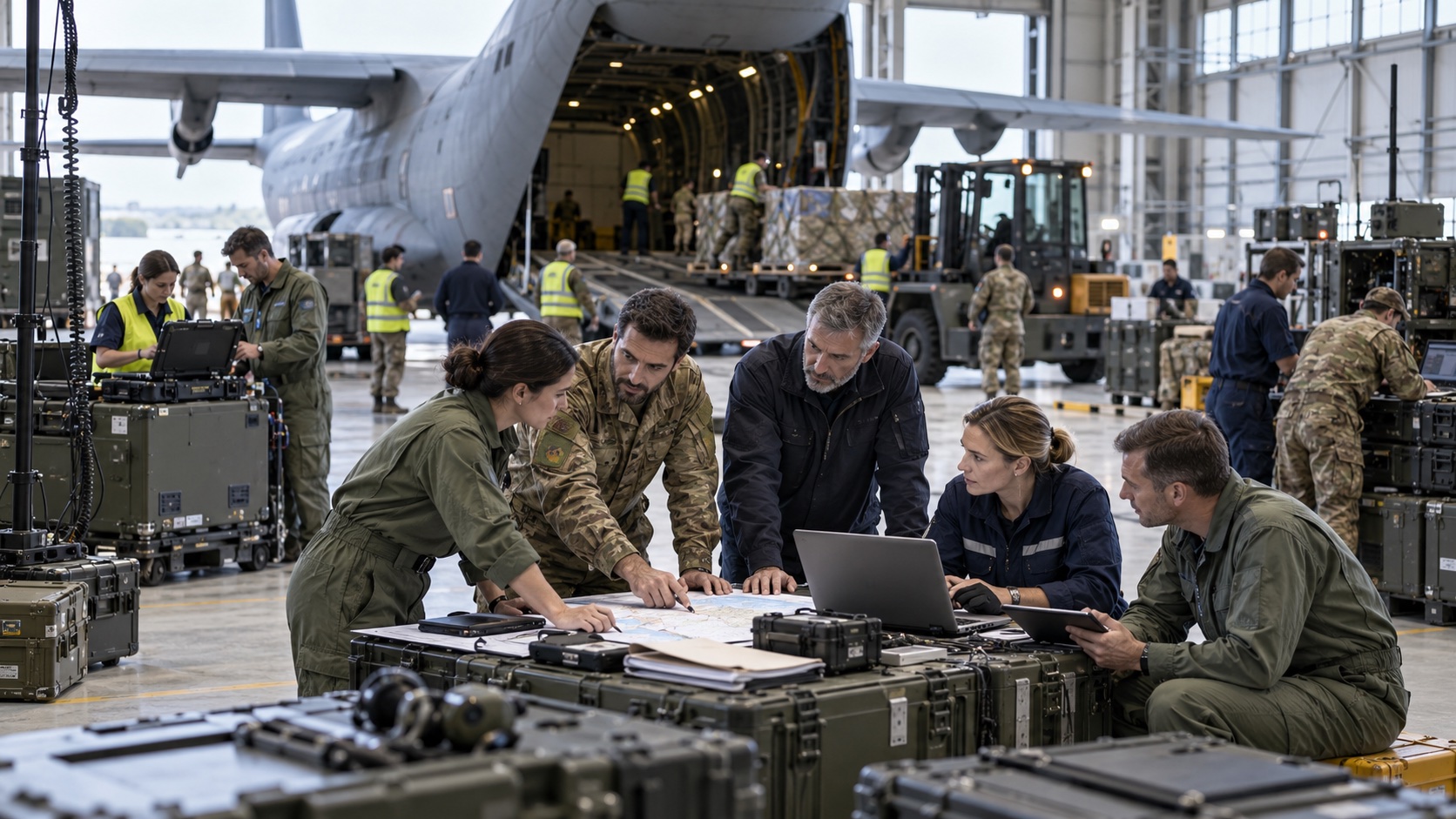
Europe has built a cooperative defence stack
Europe is no longer starting every defence conversation from a blank national page. It now has treaty-based commitments, shared research programmes, common industrial rules, financing for joint procurement, permanent multinational structures and a first set of continent-scale capability projects. That architecture is a European achievement: countries with different armed forces, strategic cultures and industries have created working ways to define needs, fund research, buy together and support operations.
The most honest reason for pride is not a headline budget. It is the emerging chain from requirement to usable capability. PESCO can align states around a project; the European Defence Fund can finance collaborative research and development; EDIP can reinforce production, supply and procurement structures; SAFE can finance large member-state purchases; and national armed forces remain the users responsible for training, staffing and operating the result. Each instrument does a different job.
That distinction matters because defence language often turns a proposal into a programme, a selected research consortium into a contract, or a loan ceiling into delivered equipment. This scorecard uses six labels: proposed, adopted, selected, financed, procured and operational. Europe should celebrate movement between those stages while refusing to count the same ambition several times.
PESCO: from binding commitments to operational structures
Permanent Structured Cooperation is the treaty-based foundation. Twenty-six EU member states participate in binding commitments covering investment, planning, capability shortfalls, operational cooperation and the European defence industrial base. PESCO's 2026 public reporting describes 74 projects across training, land, maritime, air, cyber and strategic enablers, although the live project catalogue can show a lower active total when completed or closed projects are treated separately. The useful question is what each project has produced.
Some results are already operational or becoming permanent. The Network of Logistic Hubs in Europe and Support to Operations has established an operational network of hubs. Cyber Rapid Response Teams have supported EU missions and operations. The European Medical Command has been declared operational, and the Cyber and Information Domain Coordination Centre is transitioning into a permanent EU Cyber Defence Coordination Centre. These are not complete European armed forces; they are functioning shared structures that national forces and EU missions can use.
Other PESCO projects sit earlier in the chain. The 2026 report says maritime projects including mine-countermeasure and semi-autonomous surface-vehicle work are moving toward procurement, while the European Patrol Corvette, Eurodrone, European Secure Software Defined Radio and Anti-Torpedo Torpedo connect to cooperation through OCCAR. Common requirements, demonstrators and testing are valuable, but they should be labelled development until participating states order, receive and operate systems.
The European Defence Fund: selected research and development
The European Defence Fund supplies a research-and-development layer that individual national programmes often struggled to build at continental scale. Its 2021–2027 budget is €7.95 billion. For the 2025 call results published in April 2026, the Commission selected 57 projects for €1.07 billion: €675 million for 32 capability-development actions and €332 million for 25 research projects. The selected consortia include 634 entities from 26 EU countries and Norway; small and medium-sized companies represent more than 38% of participants and receive more than 21% of funding.
Those figures describe selected projects, not 57 fielded systems. The portfolio is nevertheless broad and concrete: cyber command-and-control, drone-swarm protection, space inspection and surveillance, trusted defence AI, rotorcraft propulsion, chiplets, collaborative air combat, affordable uncrewed munitions, counter-battery systems, soldier equipment, maritime combat systems and underwater technologies. More than 15 projects support the four readiness flagships, and 14 of the selected 2025 projects are linked to PESCO.
Ukraine's experience is becoming part of the European innovation network rather than an external afterthought. The 2025 EDF results include STRATUS, an AI-supported cyber-defence project for drone swarms with a Ukrainian subcontractor, and several affordable-drone projects plan sub-calls that Ukrainian entities can enter. That does not transfer battlefield success automatically; it creates a governed route for European consortia to learn from a partner facing real war.
EDIP and five projects of common interest
The European Defence Industry Programme adds an industrial and legal bridge. Adopted in December 2025 as Regulation (EU) 2025/2643, EDIP provides €1.5 billion in grants for 2025–2027, including €300 million for a Ukraine Support Instrument. It supports manufacturing capacity, common procurement, security of supply, long-term armament structures and a European military sales mechanism with a catalogue and possible pools of available products.
EDIP also establishes European Defence Projects of Common Interest. In July 2026 the Commission proposed five first projects after assessing nine submissions: DECODER for drones and counter-drone capability; Integrated Maritime and Seabed Defence; SPACE; federated integrated air and missile defence with early warning; and Eastern Flank Watch. Council public records show the implementing decision moving to adoption in September. Identification is an important governance milestone, not proof that the five systems are already built.
The five projects are ambitious because the capability gaps cross borders by definition. DECODER aims to coordinate development, production, joint procurement and a network of drone technology hubs. The maritime project covers situational awareness and protection above and below the sea. SPACE brings together access, awareness, protection and services. The air-and-missile project connects sensors, command and layered defence. Eastern Flank Watch addresses surveillance and protection across the Union's exposed eastern geography.

The proposal's scale is also a sign of shared purpose: DECODER involves 26 member states, while each flagship must meet EDIP criteria including participation by at least four states and wider European benefit. The framework invites Commission participation and allows the High Representative and European Defence Agency to observe. NATO activities and standards are explicitly part of the consistency check; these EU projects are meant to strengthen European capability within a wider alliance, not duplicate collective defence by pretending the two institutions have the same role.
SAFE: approved finance for joint procurement
SAFE addresses the expensive move from plans toward procurement. The Security Action for Europe instrument can provide up to €150 billion in competitively priced, long-maturity EU loans to member states. The money is borrowed through EU bonds and repaid by the beneficiaries. SAFE generally rewards common procurement, covers areas from ammunition and mobility to air defence, maritime systems, strategic enablers, space, AI and electronic warfare, and sets origin and design-control conditions intended to strengthen the European industrial base.
Between February and April 2026, the Council approved maximum loan allocations for 18 member states after positive Commission assessments of their national defence investment plans. That is approved financing capacity, not €150 billion already spent or equipment already delivered. Loan agreements, pre-financing, tenders, contracts, production, acceptance and operational integration remain separate milestones. Fifteen of the 19 plans submitted include projects with Ukraine, and eligible cooperation can also involve EEA/EFTA countries and agreed partners including Canada.
Europe can be proud of using its financial capacity for common security. Joint EU borrowing gives participating countries a way to aggregate urgent demand and offer industry a larger, more predictable order horizon than fragmented annual purchases. The democratic responsibility is equally large: loans become national debt, procurement choices shape dependency for decades, and parliaments and audit bodies need enough information to judge value, competition, delivery and lifecycle cost.
Industrial capacity, partners and dependencies
Industrial eligibility rules try to keep public support connected to usable European capacity. EDIP generally requires supported companies and executive management in the EU, EU-based facilities and at least 65% of component cost from the EU or associated countries, while SAFE normally limits component costs from outside its eligible European and Ukrainian base to 35%. Stricter rules apply to sensitive category-two systems where a contractor must be able to modify equipment without a non-EU restriction.
Those rules do not make Europe self-sufficient. Modern defence depends on global semiconductors, raw materials, machine tools, software, propulsion, sensors and partner-country technologies. A resilient Europe should know where control, intellectual property, production, maintenance and upgrade authority sit, then diversify or deepen capacity where a dependency could block democratic action. The lesson of Airbus is coordination of specialisms, not isolation.
Shared digital and space infrastructure matters too. Secure positioning and timing from Galileo, computing capacity in the EuroHPC network, communications, cyber defence and Earth observation can support security while serving civilian purposes under different governance. Civil-military links can improve resilience, but they require clear legal authority, data protection, export controls and lines between civilian services and military command.
Fragmentation and democratic control
The largest limitation is still fragmentation after the programme stage. Member states own most requirements, budgets, procurement agencies, forces, stockpiles and deployment decisions. They can join a collaborative project and later order different quantities, schedules or national variants. Production capacity does not guarantee signed demand; a demonstrator does not create trained units; and a common system does not become interoperable without doctrine, secure communications, maintenance, ammunition, exercises and commanders who can use it together.
Democratic control is the next European capability. The Federal Europa guide to democratic European defence argues that shared power must be matched by transparent mandates and accountable institutions. Secrecy protects operations and sensitive technology, but programme status, public money, broad requirements, delivery milestones, industrial concentration and audit findings should be visible enough for citizens and parliaments to distinguish security from procurement optimism.
A useful public scorecard should therefore ask: Is the legal instrument adopted? Is funding a grant, loan ceiling, allocation, signed agreement or disbursement? Has a consortium been selected and contracted? Is there a prototype, production line, procurement contract, delivered unit, trained formation or operational service? Who owns design authority and upgrades? Which country carries lifecycle cost? How does the project fit NATO planning, Ukrainian cooperation and the security policy of neutral member states?
What Europe can be proud of now
Europe's achievement in 2026 is real even with those questions open. It has moved beyond occasional bilateral projects toward a connected public system for priorities, research, industry, finance and operations. Logistics hubs work, cyber teams deploy, medical coordination exists, multinational research is funded, common procurement has financial backing and continent-scale gaps have named projects. The next test is demanding and measurable: turn that architecture into equipment and services delivered on time, maintained in Europe, interoperable in practice and controlled democratically.