The right to fly and receive free assistance
The short answer is practical. A passenger with a disability or reduced mobility has a right to book and travel without discrimination and to receive free assistance through the airport and on the aircraft. The right is not limited to permanent wheelchair users. Regulation 1107/2006 covers reduced mobility caused by physical, sensory or intellectual disability, age or another factor, including a temporary condition that makes the normal airport journey difficult.
For a flight departing from an EU airport, the protection applies regardless of the airline's nationality. It also covers transit through an EU airport. For a journey arriving from outside the EU, the Regulation applies when the flight is operated by an EU carrier. Iceland and Norway apply the rules through the European Economic Area; Switzerland has corresponding air-passenger arrangements, but passengers should check the exact national route and enforcement body.
Notify early—and still ask if notice is late
Request assistance when booking or as soon as the need is known. Send the request to the airline, its agent, the ticket seller or the tour operator at least 48 hours before the published departure time. State what you can do independently, where help is needed, whether you can use stairs, the dimensions and weight of a mobility device, its battery type, any detachable parts, and whether a recognised assistance dog will travel. Keep the confirmation in an accessible form.
The 48-hour notice is a planning rule, not permission to abandon a late passenger. If advance notice was not given, the airport and airline must make every reasonable effort to provide assistance so the person can take the booked flight. The result can be less predictable because suitable staff, lifting equipment or cargo space may not be ready. Ask anyway, arrive early and record who received the request.
What airports and airlines must provide
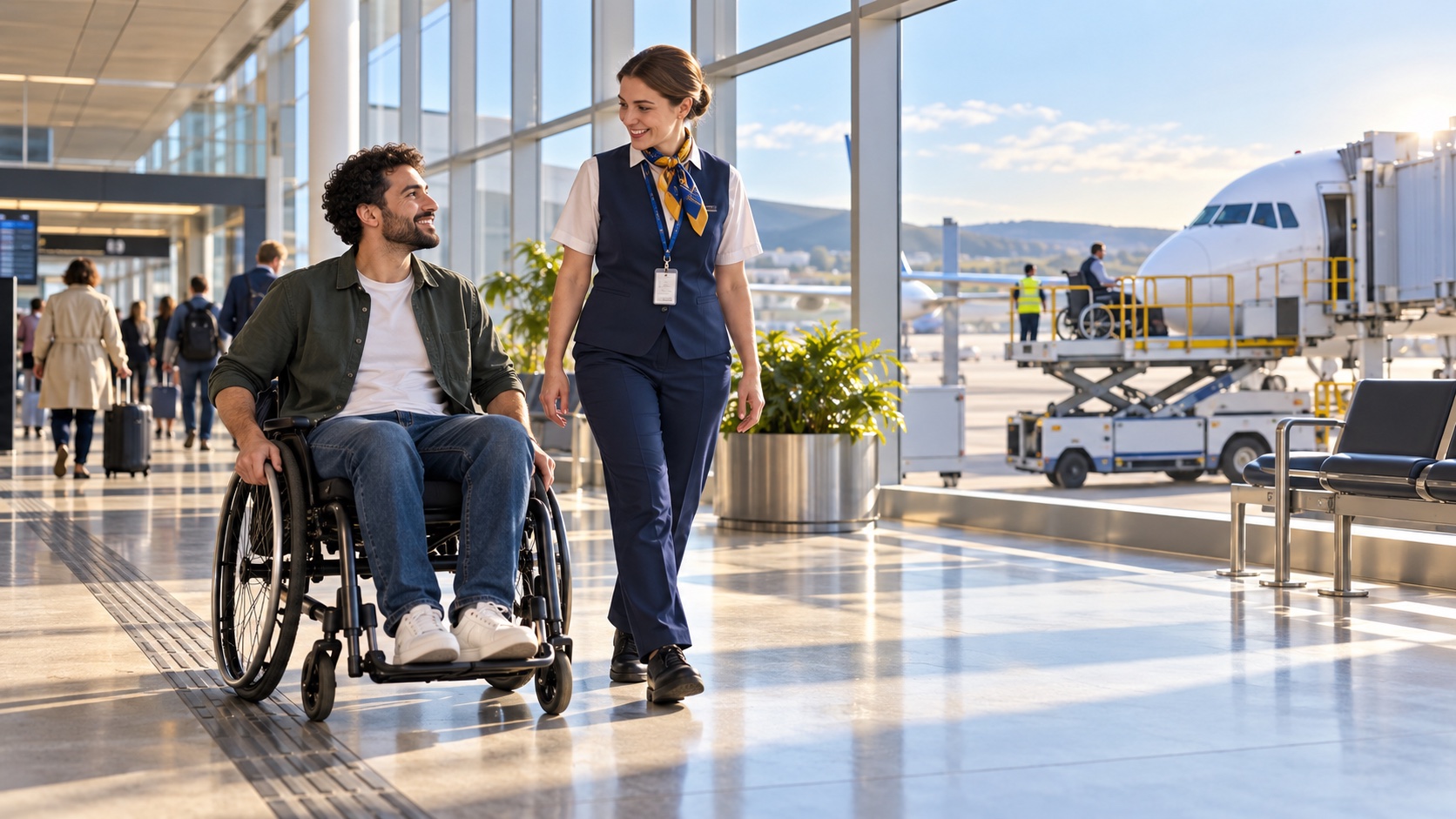
The airport manages assistance on the ground. It must provide designated arrival points, help the passenger reach check-in, handle luggage, pass security and border controls, reach the gate, board, find the seat, disembark, retrieve baggage and mobility equipment, and continue to a connecting flight or a designated exit point. Assistance should be adapted to the person rather than forcing everyone into one standard process.
The airline is responsible for assistance on board. That includes communicating essential flight information in accessible formats, making reasonable efforts to meet seating needs and seat an accompanying helper nearby, carrying recognised assistance dogs in the cabin under applicable rules, and helping a passenger move to the toilet facilities if required. Cabin crew are not required to lift a passenger, provide help inside the toilet, feed someone or administer medication.
Companions, safety and refusal
That boundary matters when deciding whether to travel with a personal assistant. An airline cannot require a companion merely because someone needs comfort or personal-care help. It may require a safety assistant only where the passenger cannot independently meet applicable aviation-safety requirements and this creates a genuine safety risk—for example, understanding the safety briefing or reaching a suitable exit in an emergency. The assessment must be individual, not based on assumptions about a diagnosis or appearance.
Refusal is exceptional. An airline cannot reject a booking or boarding simply because of disability or reduced mobility. It may rely on a binding safety requirement or a physical impossibility such as an aircraft door too small for the necessary embarkation. It should explain the reasons immediately and in writing on request, consider a reasonable alternative, and offer reimbursement or rerouting where the Regulation requires it. An unlawful disability-based refusal can also trigger the ordinary denied-boarding remedies.
Assistance dogs and mobility equipment
A recognised assistance dog must be accommodated without an extra fare when pre-notified and when the applicable animal-entry, health, training and safety rules are met. EU law does not yet provide one certificate that every carrier must accept. Ask for the airline's current evidence and restraint requirements and check destination animal rules well before travel. The dog is not ordinary cabin baggage and should not be confused with a pet accepted under a commercial pet policy.
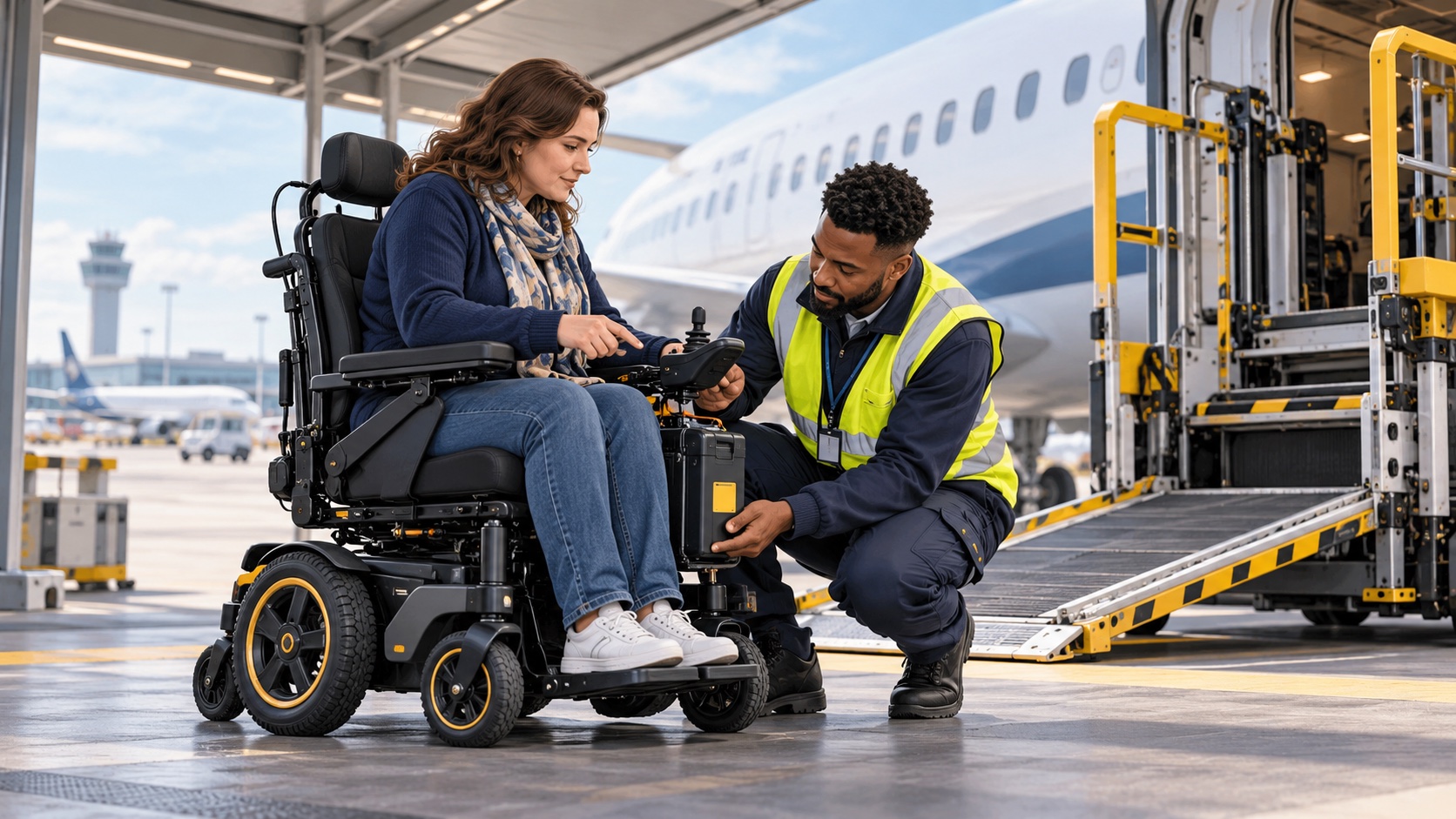
Up to two pieces of mobility equipment, including an electric wheelchair, must be carried free of charge in addition to medical equipment, subject to advance warning, aircraft space and dangerous-goods rules. Obtain the airline's instructions for the exact battery chemistry. Give clear isolation, folding, lifting and reassembly instructions, label detachable controls and cushions, and carry removable parts or approved batteries in the cabin only when the airline confirms that method.
Protect the wheelchair handover
Photograph the equipment from several angles immediately before handover. Record make, model, serial number, dimensions, weight, replacement value and existing marks. Attach a concise handling sheet without exposing unnecessary health data. At the gate, confirm the point at which the chair will be taken and where it will be returned. If an aisle chair or temporary device is needed, ask how the transfer will work and who is responsible at each stage.
Damage, temporary equipment and compensation
If the wheelchair or another mobility aid is delayed, damaged or lost, report it before leaving the airport whenever possible. Tell both the airline and the airport assistance desk because the handling chain can involve several organisations. Obtain a written property-irregularity or damage report, photograph the condition, preserve boarding documents and receipts, and state the urgent functional consequences—not only the repair price. Ask for an appropriate temporary replacement, although current law does not promise a like-for-like model.
Current compensation for mobility-equipment damage can be constrained by the Montreal Convention baggage-liability framework, depending on the claim and route. A special declaration of interest at check-in can raise the carrier's liability limit, but today a carrier may charge a supplementary sum. Ask in advance how to make the declaration and what evidence of value is required. Do not assume that a normal baggage form fully records a wheelchair's replacement cost or the loss of independence caused by damage.
What changes from 23 October 2027
A major reform has already been adopted but is not yet today's rule. Regulation (EU) 2026/2202 was published on 2 October 2026 and applies from 23 October 2027. It will require airlines to offer the special declaration for mobility equipment and recognised assistance dogs free of charge, strengthen full-replacement-cost protection within that system, and give compensation, rerouting and assistance when inadequate airport help causes a passenger to miss a flight. Until the application date, claim under the rules currently in force.
Disruption and the Accessibility Act boundary
Disruption does not suspend accessibility. If a flight is cancelled, delayed or rerouted, tell the carrier and assistance desk that the replacement journey must work with the passenger's mobility needs, equipment and companion. A nominal rerouting option is not comparable if the passenger cannot board the substitute transport or the necessary assistance is unavailable. The site's flight-delay guide and denied-boarding guide explain the parallel Regulation 261 remedies.
Accessible booking and airport services are related but legally distinct. The European Accessibility Act guide covers accessible e-commerce and transport-service information for many products and services placed on the market from June 2025. Regulation 1107/2006 governs the personal assistance and non-discrimination duties around the flight. Record whether a barrier occurred in the booking interface, at the terminal, during boarding, on board or in equipment handling.
Complaint route and evidence file
Complain first to the organisation responsible for the failure. Use the airport for missing or poor ground assistance and the operating airline for onboard service, carriage, refusal or equipment handling under its control; copy both if responsibility is unclear. Give the booking reference, flight, airports, dates, assistance request and confirmation, arrival time at the designated point, names or descriptions of staff, the precise failure, losses and the remedy requested.
If the answer is missing or inadequate, use the national enforcement body for Regulation 1107/2006 in the country where the incident occurred. The European Commission maintains the current list. An enforcement body may investigate compliance and impose national sanctions, but the route for individual damages can differ. Alternative dispute resolution, a national equality body, consumer centre, ombudsman or court may also be relevant. Preserve limitation periods rather than waiting indefinitely for informal replies.
A useful travel file therefore has three layers. The assistance layer contains the confirmed request, meeting point, timings and contact numbers. The equipment layer contains photographs, specifications, battery and handling instructions, value and repair contacts. The rights layer contains the responsible airport, operating carrier, enforcement body and complaint route. Share only what staff need to provide safe assistance.
The European freedom still being completed
Europe has already made an important principle operational: the freedom to travel belongs to people whose bodies and needs do not fit an assumed standard passenger. The remaining test is consistency. A right is only real when the request survives booking systems, handovers, contractors, connections and disruption without forcing the passenger to coordinate the airport from the wheelchair.
A more federal passenger-rights system would preserve local airport expertise while using one accessible assistance record, one clear liability chain and remedies that follow the person across a multi-airport journey. The law has moved closer to that model, and the 2027 reform strengthens it. For today's trip, the best protection is still early, precise notice backed by a documented handover and a complaint addressed to the right organisation.