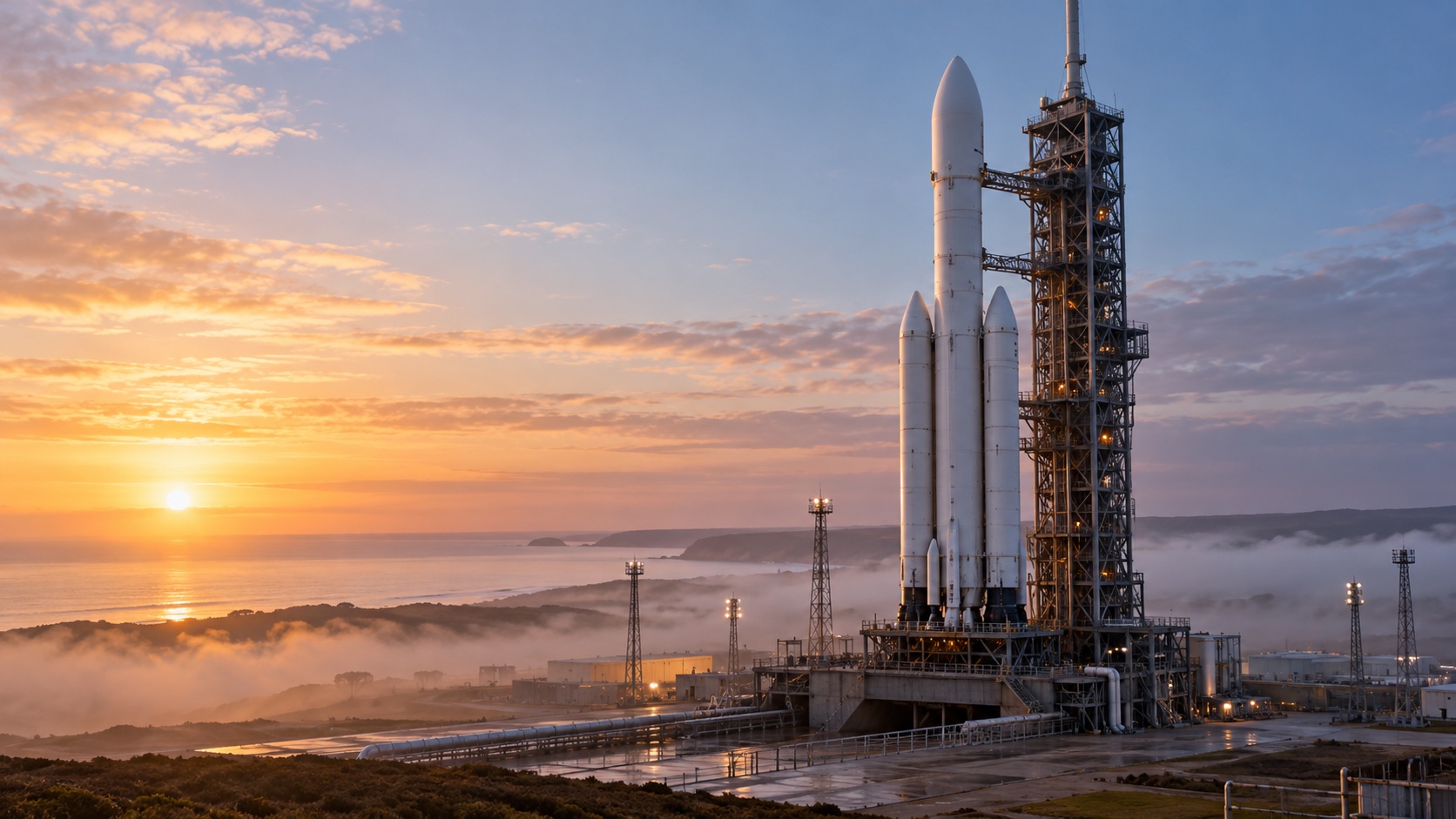
Europe again has an operational route to orbit
Europe built and brought into service a new family of launch vehicles. Ariane 6 is not a model on a trade-show stand or a promise awaiting a maiden flight: it is an operational medium- and heavy-lift system that has carried defence, weather, Earth-observation, navigation and commercial constellation payloads. Through 25 September 2026, nine Ariane 6 flights had left Europe's Spaceport, and the programme had moved from proving the launcher to raising cadence, performance and order-book depth.
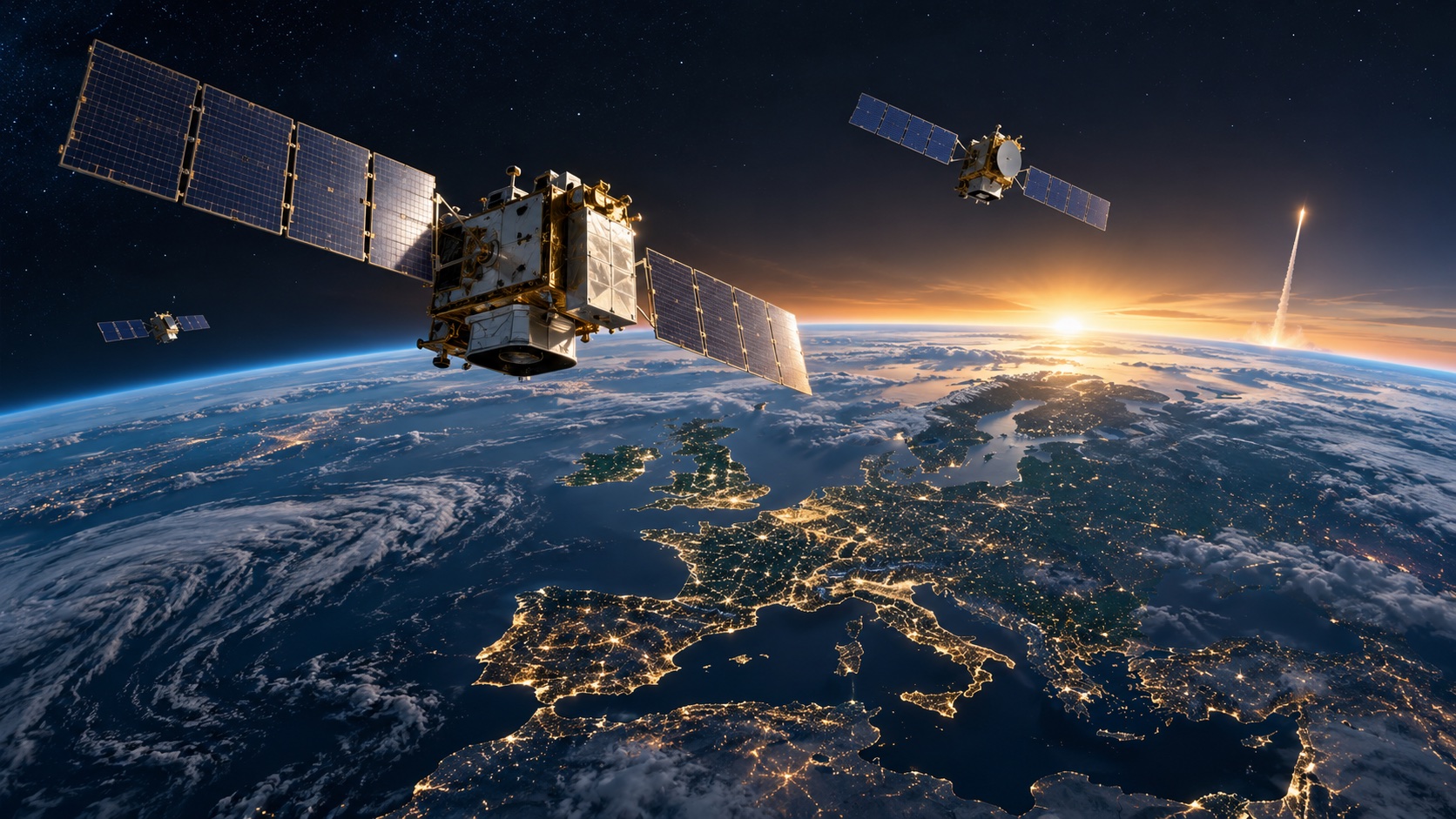
That matters because satellites do not become public capability until a launcher can place them where they need to work. Europe's Galileo navigation system, EUMETSAT weather service, Copernicus observation fleet, defence missions, communications and science all depend on access to orbit. Buying a launch abroad can be sensible; being unable to launch critical missions without another power's schedule, export decisions or strategic consent is a vulnerability.
A shared programme and a 13-country industrial network
Ariane 6 is a shared European system with distinct responsibilities. ESA member states decided to begin development in 2014; ESA manages and finances the programme; ArianeGroup is the industrial prime contractor and design authority; Arianespace markets and operates launch services; France's space agency CNES owns and prepares much of the ground infrastructure at the Guiana Space Centre; and companies across Europe manufacture engines, structures, avionics, boosters and stages. No single flag explains the whole vehicle.
The industrial network is itself an achievement. ArianeGroup says it coordinates more than 600 partners and suppliers in 13 contributing European countries, including about 350 small and medium-sized companies and start-ups, supporting more than 13,000 direct and indirect jobs. Those figures come from the prime contractor and should be read as its current programme account, but the underlying point is visible: Europe preserved specialist propulsion, cryogenic, composite, software, test and integration knowledge across borders instead of letting a complete capability disappear.
Two configurations and a restartable upper stage
The launcher has two main configurations. Ariane 62 uses two solid boosters for medium missions; Ariane 64 uses four for heavier payloads and more demanding destinations. ArianeGroup lists approximate low-Earth-orbit capability of 10.3 tonnes for Ariane 62 and 21.6 tonnes for the original Ariane 64 configuration, with respective geostationary-transfer capability of about 4.5 and 11.5 tonnes. Customers can also choose fairing length and mission profiles suited to different spacecraft.
Versatility comes especially from the upper stage. Its Vinci engine can restart several times, while an Auxiliary Power Unit supports tank pressurisation, propellant settling and extended mission sequences. That lets one launch deploy several spacecraft, reach different orbits and direct the upper stage toward safer disposal. The architecture is designed for navigation satellites, observation missions, large constellation batches and missions beyond Earth—not one narrow commercial orbit.
From the launch gap to the 2024 maiden flight
Europe reached this point after a genuine capability gap. Russian Soyuz operations from French Guiana ended after Russia's full-scale war against Ukraine, Ariane 5 made its final flight in July 2023 and Vega-C was then returning from a failure. Ariane 6 also arrived later than originally planned. For a period, European institutional satellites flew on non-European launchers. The delay was strategically uncomfortable precisely because the continent understood what autonomous access was worth.
The inaugural Ariane 6 flight on 9 July 2024 deployed its primary payloads, demonstrated the core launcher and upper-stage restart, but did not complete the final upper-stage burn and disposal experiment after an Auxiliary Power Unit shutdown. Engineers analysed millions of data points and corrected the flight software before the next mission. That is neither a failure to hide nor a reason to deny the achievement: flight testing exposed a late-mission problem, the root behaviour was understood and the operational sequence advanced.
Nine missions built operational confidence
The first commercial flight followed on 6 March 2025 with France's CSO-3 observation satellite. Ariane 62 then carried MetOp-SG-A1 for EUMETSAT, Sentinel-1D for the EU's Copernicus programme and two more Galileo satellites during 2025. Those missions turned launch autonomy into useful European services: better weather forecasting, radar observation, secure public capability and navigation available to citizens and organisations far beyond the space sector.
The heavy Ariane 64 configuration first flew on 12 February 2026, placing 32 Amazon Leo satellites in low Earth orbit. A second batch of 32 followed in April. On 17 June, a third Ariane 64 introduced the longer P160C solid motors and placed 36 satellites in orbit. Arianespace described that mission as the heaviest payload ever carried by an Ariane launcher; the three flights deployed 100 Amazon satellites in less than five months and demonstrated that a publicly enabled European launcher can also win and execute large global commercial campaigns.
The P160C is an important example of evolution after entry into service. It keeps the broad booster architecture while carrying 156 tonnes of solid propellant rather than 142 tonnes in the P120C, increasing performance by roughly 10–15% for relevant low-orbit missions according to Arianespace. Common booster technology also supports Vega-C. Europe is not treating the first operational design as finished; it is using production and flight experience to increase payload and broaden the mission set.
On 27 August 2026, Ariane 62 carried the MTG-I2 weather satellite on Ariane 6's first mission to geostationary transfer orbit. That ninth flight was the farthest Ariane 6 had flown and completed a mission type central to telecommunications and weather systems. MTG-I2 joined a European weather architecture capable of scanning Europe and northern Africa rapidly for severe-weather monitoring, making the launcher-to-service connection unusually direct.
Commercial customers, global partners and real autonomy
Commercial confidence is growing too. In September 2026, Arianespace announced seven agreements and memoranda covering almost ten Ariane 64 launches, its largest order intake since the launcher entered service. Confirmed elements included additional missions for Amazon Leo and Eutelsat's OneWeb renewal, while other agreements opened paths for European spacecraft and orbital-transfer companies. Contracts, memoranda and successful launches are different levels of evidence, but the direction is meaningful: customers are planning around the launcher rather than merely waiting for it.
The programme also links Europe to the global market without surrendering its European purpose. Amazon is American; components and materials move through international supply chains; satellites may come from any customer that meets export, security and launch requirements. Autonomy does not mean autarky. It means Europe controls a credible launch option, retains engineering and operational knowledge, and can choose partnerships from a position of capacity rather than dependence.
Europe's Spaceport, French Guiana and environmental responsibility
Europe's Spaceport makes that capacity possible. It sits near Kourou in French Guiana, an overseas department and region of France on the South American continent. Its latitude just over five degrees north of the equator provides useful rotational energy for eastward launches. ESA records more than 240 launches since 1990, about 1,700 workers and 42 companies across a 690-square-kilometre site. Ariane stages cross the Atlantic on the Canopée cargo ship, then meet boosters, payloads and a dedicated mobile-gantry launch complex.
French Guiana should not appear only as a convenient point on a rocket diagram. The spaceport occupies land, shapes employment and infrastructure, and exists within a society with its own economic and environmental priorities. European pride is stronger when local people, institutions and ecosystems are treated as participants rather than scenery. ESA says the large protected perimeter contains substantial biodiversity; operations still require transparent impact management, local procurement, training and accountability.
Launches also have environmental costs. Cryogenic main stages use liquid hydrogen and oxygen, while solid boosters release combustion products; manufacturing, transport, ground operations and upper-stage disposal add impacts. Space systems can improve climate and disaster knowledge, but that public value does not erase launch emissions or debris risk. Ariane 6's restartable upper stage, disposal planning and the hybrid-sail Canopée are useful engineering choices, not permission to market orbital activity as impact-free.
Cadence, cost and competition are the next tests
The main competitive limitation is also clear: Ariane 6 is expendable in a market transformed by reusable launchers and aggressive commercial cadence. Europe must prove reliable production, shorter launch campaigns, stable prices and enough annual flights to serve institutional missions without losing global customers. ArianeGroup says the industrial system is designed for 11 launchers a year and launch-pad operations as close as 15 days apart; those are capacity claims to demonstrate through sustained delivery, not achieved annual averages.
Public support remains essential. ESA states provide development and evolution funding, European institutions anchor demand, and launch-service arrangements protect the strategic system through its ramp-up. That is not unique to space or proof of failure: major launch systems around the world grow through state procurement, infrastructure and security demand. The democratic test is whether support buys measurable readiness, competitive pressure, transparent costs, useful missions and a credible path to continuous improvement.
Ariane 6 is therefore one part of a wider European launch portfolio. Vega-C serves smaller missions, while the European Launcher Challenge and national programmes are intended to create more commercial providers and competition. The first orbital launch from Andøya showed the ambition and risk of Europe's emerging launch companies. A resilient continent should not ask one rocket to cover every payload, orbit, price and contingency.
The next scorecard is practical: how many launchers are delivered each year, how reliably they fly, how quickly missions move through the spaceport, whether costs become competitive, whether European institutional payloads receive assured slots, how P160C performs across repeated flights, and whether future upgrades reduce environmental and operational burdens. A full order book is valuable only when factories and the launch base convert it into missions on time.
A working example of federal capacity
For Federal Europa, Ariane 6 is a clear federal story. ESA member states pooled long-term risk; specialised industries produced different parts; a European prime integrated them; a French and Guianese launch base provided common infrastructure; European public programmes supplied missions; and one operator serves public and commercial customers. Each level owns a real responsibility, while none could produce independent access alone.
Europeans can be proud of the result. The continent absorbed delay, a dangerous launch gap and a changing global market, then fielded both configurations, upgraded the boosters and flew nine missions across low, sun-synchronous, navigation and geostationary-transfer profiles. Ariane 6 does not end Europe's launcher debate. It gives that debate a working rocket, a living industrial base and the freedom to make the next choice from orbit-capable ground.