A permanent European machine for difficult missions
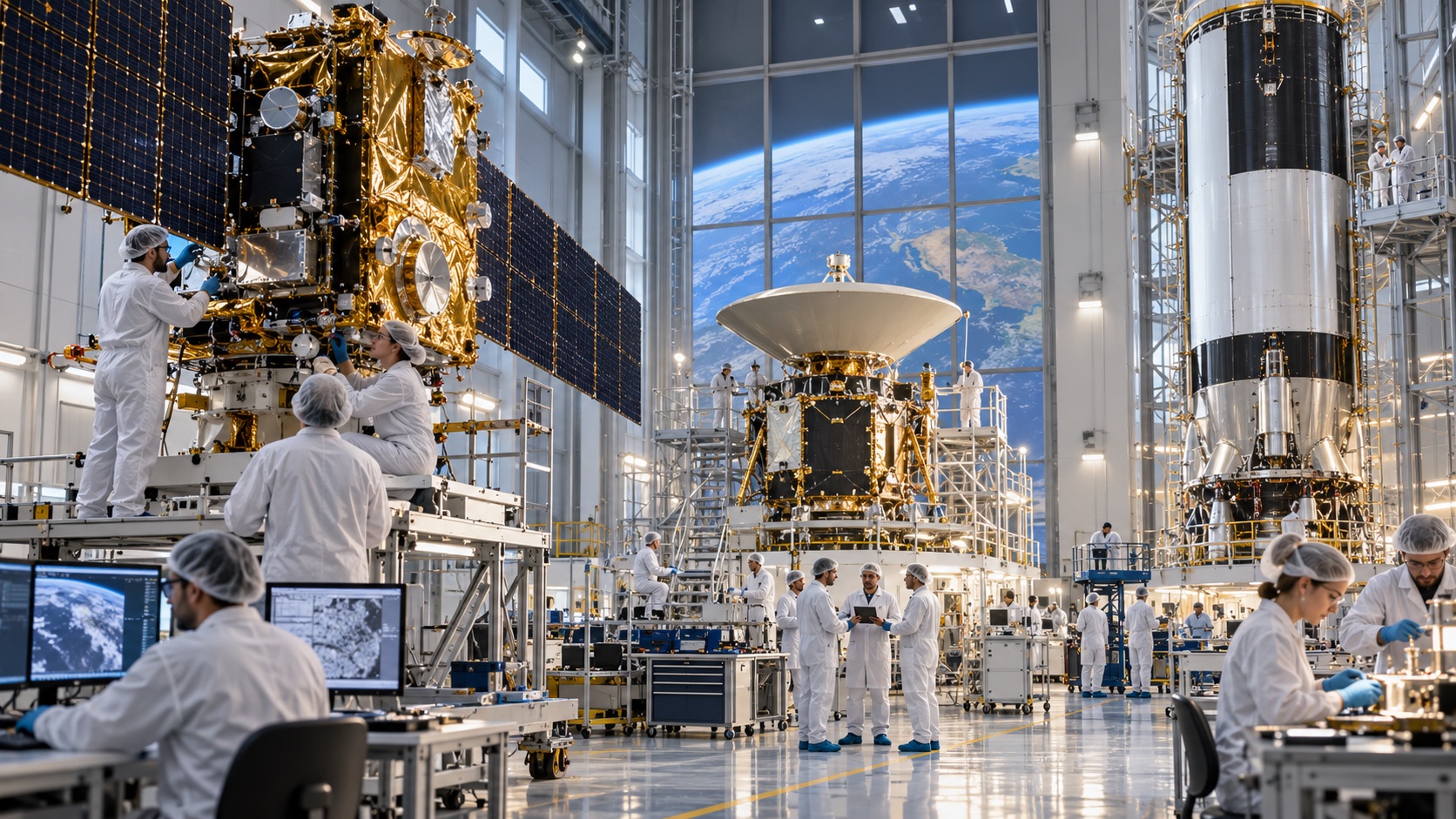
The European Space Agency is one of the clearest proofs that being European is itself a strategic advantage. Twenty-three countries pool money, engineers, laboratories, mission-control expertise and industrial capacity inside a permanent institution able to work across decades. The result is not one famous rocket or telescope. It is the machinery that repeatedly turns a scientific question or public need into spacecraft, ground systems, data, trained people and knowledge Europe can keep using.
Twenty-three states, one independent agency
ESA was created when European states decided that fragmented national programmes could not provide the scale or continuity space demanded. Ten founding states signed the Convention in 1975, merging the earlier research and launcher organisations into one agency with a wider remit. The Convention entered into force in 1980. Slovenia's accession on 1 January 2025 made it the twenty-third member state, while associate and cooperating arrangements connect the remaining EU countries and Canada participates through a separate cooperation agreement.
ESA is European, but it is not the European Union. Norway, Switzerland and the United Kingdom are ESA members outside the EU, while several EU countries are associates or cooperating states rather than full members. The EU owns and governs programmes such as Galileo and Copernicus; ESA supplies major design, development, procurement and technical work under agreements. EUSPA provides EU space-programme services, EUMETSAT operates meteorological satellite systems and national agencies keep their own missions. Europe's strength comes from making those boundaries cooperate rather than pretending one institution does everything.
Mandatory solidarity and optional coalitions
The funding model is designed for both solidarity and choice. Every member contributes to mandatory activities—especially the science programme and basic technical capacity—on a scale linked to national income. Optional programmes let countries subscribe according to their priorities in Earth observation, telecommunications, navigation, transportation, human spaceflight and exploration. That flexibility keeps smaller and larger states inside one framework while allowing coalitions to build missions without requiring identical national space policies.
Rosetta, Gaia and Euclid: science across decades
Science shows what long-term shared capacity can achieve. Rosetta became the first mission to orbit a comet's nucleus and deliver a lander to its surface. It travelled for a decade before reaching comet 67P, then observed the body through its changing solar environment. Instruments came from European and American institutes and the Philae lander from a European consortium. Europe led the mission while global participation strengthened the evidence—an achievement of integration, not isolation.
Gaia transformed the scale of galactic measurement. From July 2014 to January 2025 it made more than three trillion observations of about two billion stars and other objects, building the largest and most precise three-dimensional map of the Milky Way. The spacecraft is retired, but its data-processing consortium will keep releasing and analysing the catalogue for years. Europe's accomplishment includes the less visible work: stable optics, worldwide ground stations, operations in Germany, science operations in Spain and a continent-wide data community.
Euclid extends that ambition to the dark Universe. Launched in 2023, it is observing billions of galaxies across more than a third of the sky to map how cosmic structure changed over ten billion years. ESA leads the mission, a European consortium provides instruments and science processing, and NASA contributes detectors and support. Euclid launched on a United States Falcon 9 during Europe's launcher gap. That dependency is material; it also shows why a mature European institution can preserve the mission by managing an international alternative rather than sacrificing the science.
Galileo, Copernicus and weather: the European division of labour
Space science is only one layer. ESA engineering helped build the Galileo navigation system, whose services now reach billions of compatible devices, and the Copernicus Sentinel system, whose open observations support climate, land, oceans, atmosphere and emergencies. These are EU programmes, not ESA property. The pride lies in a European division of labour where public ownership, technical expertise, service operations and national capabilities connect without erasing institutional accountability.
Weather gives another view of that chain. ESA develops new generations of meteorological spacecraft with industry, while EUMETSAT operates shared weather satellites and national services turn observations into public forecasts and warnings. ESA also builds Earth-science missions that measure forests, ice, oceans, gravity, winds and the atmosphere. A satellite is not a climate policy or emergency response by itself, but it creates common evidence that twenty-seven separate observing programmes would struggle to sustain with the same continuity.
Launchers and human spaceflight
Europe's access to orbit is equally institutional. ESA member states created launcher programmes, Europe's Spaceport in French Guiana and the technical foundations for Ariane and Vega. The Ariane 6 programme restored an operational European medium- and heavy-lift route after a painful gap. Launch cadence, cost, reusability and competition remain demanding tests. ESA's achievement is not that Europe can ignore global launch markets; it is that Europeans retain the capacity to choose, engineer and govern an independent route for strategic missions.
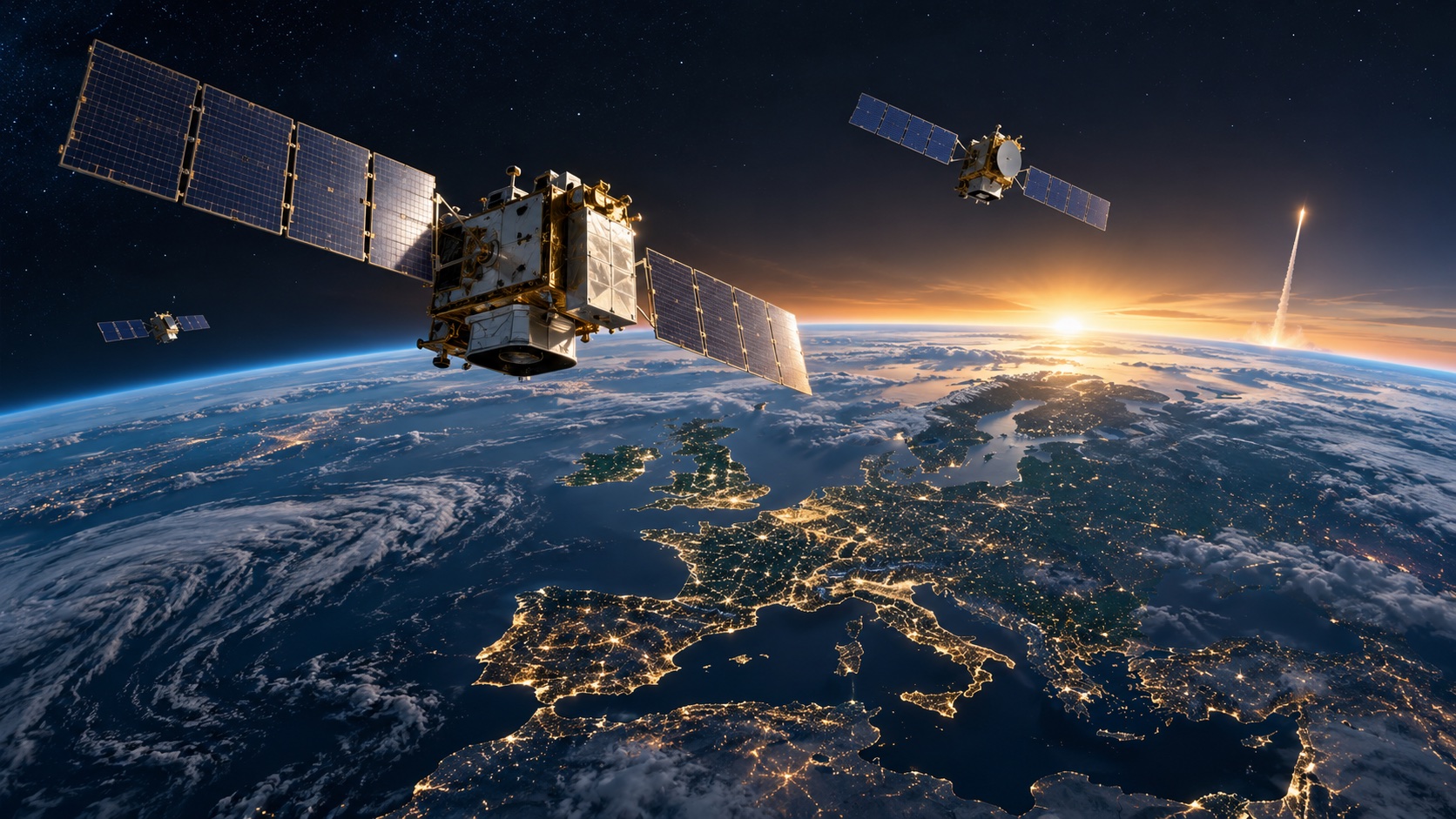
Human spaceflight combines autonomy and partnership. European industry built the Columbus laboratory for the International Space Station, ESA trains astronauts and European control centres operate mission elements and experiments. Access to the station depends on international vehicles and the station itself is a partnership with the United States, Japan, Canada and Russia. Europe contributes high-value infrastructure and people inside a global project while debating the next steps in low Earth orbit and exploration beyond it.
A distributed agency and continental industrial base
The network on Earth makes all of this repeatable. ESA headquarters, the ESTEC technical centre in the Netherlands, ESOC mission control in Germany, ESRIN Earth observation in Italy, the astronaut centre in Germany, astronomy in Spain, telecommunications activity in the United Kingdom, security and education sites and ground stations across several continents form one distributed agency. A mission can be conceived, tested, launched, operated, archived and studied through facilities that no one member had to duplicate alone.
Industrial policy turns public programmes into capability across the member states. ESA procurement seeks technical quality and competitiveness while applying geographical-return rules so industrial participation broadly reflects national contributions. That approach has helped firms and specialist suppliers enter a continental value chain, including smaller countries and SMEs. It also creates tension: geographic balance can complicate procurement and should never become a substitute for performance, open competition or clear responsibility. ESA publishes the rule because the trade-off must be managed, not hidden.
The industrial result reaches beyond spacecraft. European companies built prime-contractor, propulsion, optics, electronics, software, robotics, antenna, operations and testing expertise through ESA missions. The Airbus story shows a parallel production logic in aviation: national strengths become strategically meaningful when they operate as one system. Space technology transfer, business incubation and common qualification work can spread methods and components into other sectors, though every claimed spin-off still needs evidence rather than mythology.
Global partners, dependencies and environmental costs
Global inputs are part of the honest picture. European missions use non-European launchers, instruments, chips, software, stations and scientific partners; non-European missions use European hardware and researchers. Supply-chain concentration, radiation-hardened electronics, launch availability and export controls can constrain choices. Cooperation with NASA and other agencies expands what Europe can attempt, but dependence becomes risky when there is no alternative for a critical layer. ESA's task is to decide which capabilities must remain available in Europe and where partnership creates more value than duplication.
Space itself imposes costs. Launch and manufacturing have environmental footprints; constellations affect crowded orbits and astronomy; debris raises collision risks; programmes can overrun budgets or arrive years late; and public money has opportunity costs. Planetary defence, debris mitigation, cleaner propulsion and sustainable mission design are not decorative additions. Pride in a space institution should make scrutiny stronger, because a shared European capability belongs to citizens who are entitled to ask what it costs, what it delivers and who carries the risk.
The unfinished governance test
The governance model is also unfinished. Optional participation can fragment priorities, ministerial subscriptions can create stop-start planning and Europe still lacks fully autonomous capability in some critical technologies, launch categories and human transport. Commercial competitors move quickly, while public programmes must satisfy safety, procurement and national agreement. Those are real pressures. They do not cancel five decades of delivered missions; they define the next test for strategy, speed and democratic accountability.
Why ESA is a European achievement
Europe can be proud of ESA because it made patience operational. Rosetta's comet, Gaia's stellar map, Euclid's dark-Universe survey, Copernicus observations, Galileo engineering, Ariane launchers, Columbus and hundreds of smaller missions emerged from a durable constitutional choice: share the hardest layer and let scientists, countries and companies build on it. The Proud Europe hub follows achievements like this because they show what Europeans already own together—and why a democratic federal Europe should make that common capacity visible, accountable and ambitious.