Europe turned the dark universe into a shared mission
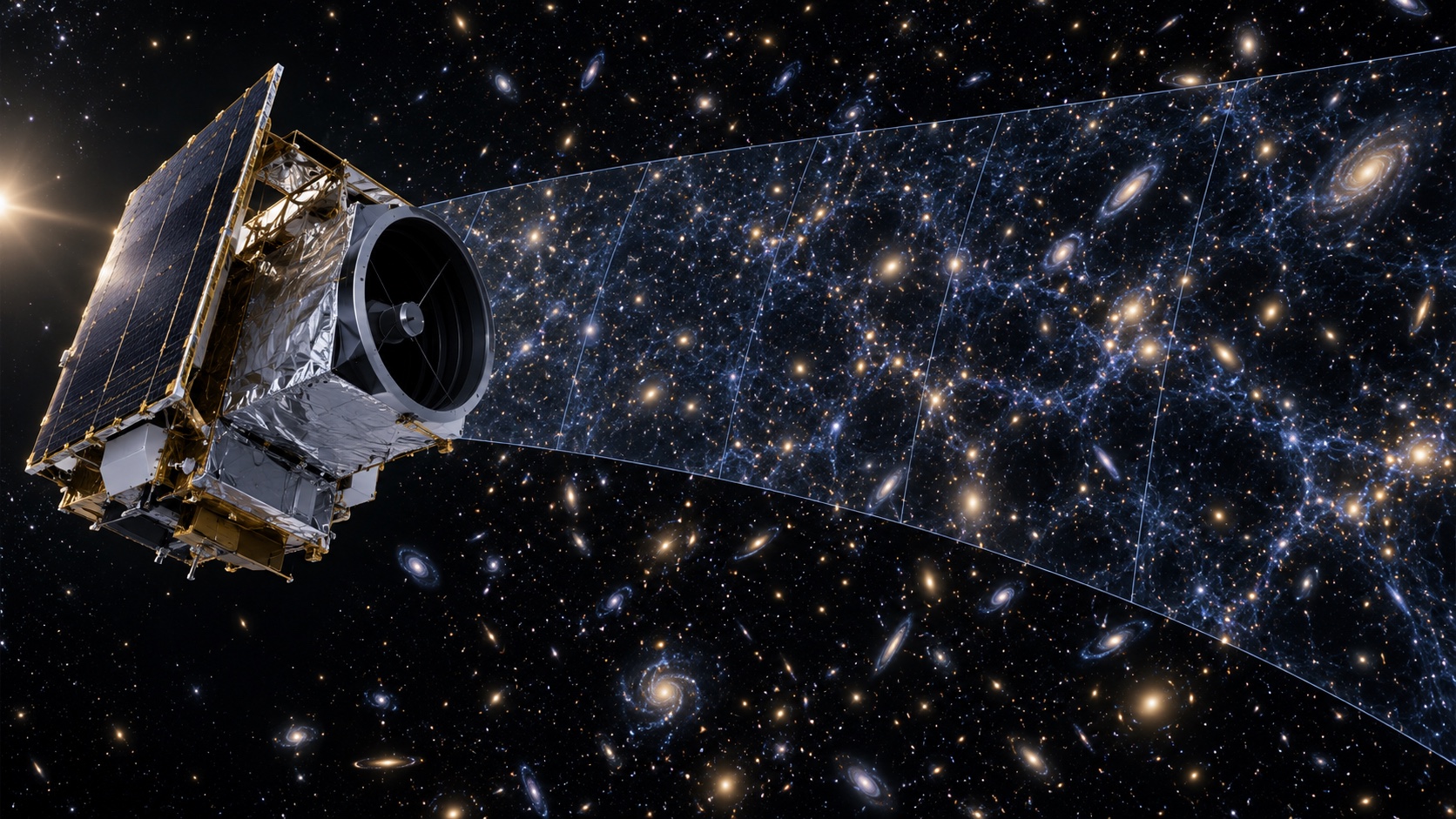
Europe decided that the invisible structure of the Universe was a problem worth solving together. The result is Euclid, the European Space Agency observatory now surveying the sky from around the Sun-Earth L2 point, roughly 1.5 million kilometres from Earth. Its goal is not to photograph dark matter or dark energy directly. It measures how galaxies are shaped, distributed and moving across cosmic time, then uses those patterns to test how gravity, structure and expansion evolved over the past ten billion years.
That distinction makes the achievement more impressive, not less. Dark matter reveals itself through gravity, including the tiny distortions called weak gravitational lensing that foreground mass imprints on the apparent shapes of background galaxies. Dark energy is the name given to whatever drives the observed accelerated expansion. Euclid turns both questions into a survey problem: observe an enormous area with stable instruments, measure galaxy shapes and distances consistently, and compare the resulting three-dimensional structure with competing cosmological models.
Who built Euclid—and where international partners fit
Euclid is a European mission built and operated by ESA, an intergovernmental European organisation rather than an EU agency. It grew from two European mission concepts, DUNE and SPACE, selected and combined under ESA's Cosmic Vision programme. ESA chose Thales Alenia Space as prime contractor for the spacecraft and service module, and Airbus Defence and Space for the payload module and telescope. The wider ESA achievement is the institutional capacity that allowed many states to choose one demanding scientific instrument and sustain it over decades.
The mission is also honestly international. It launched on an American SpaceX Falcon 9 after the planned Soyuz route became unavailable. NASA supplied the detector systems for the near-infrared NISP instrument and supports United States participation and a complementary archive. Scientists and institutes in Canada and Japan also contribute. Europe remains central because ESA owns mission responsibility, European industry built the observatory, national European agencies financed most consortium work, and European institutes lead the instruments, ground segment and survey. Credible pride names the partners instead of airbrushing them away.
Responsibility map: ESA, consortium, industry and archives
The first information-gain asset is a responsibility map. ESA controls the mission, spacecraft operations, survey planning, downlinked data intake and long-term archive. The Euclid Consortium provided the VIS and NISP scientific instruments and is responsible for much of the processing, data products and scientific exploitation. National agencies and institutes fund teams and data centres. Thales Alenia Space and Airbus delivered major spacecraft and payload systems. NASA contributed NISP detectors and United States science support. Researchers worldwide use validated releases; none of those users becomes the owner of the mission merely by publishing a discovery.
How VIS, NISP, lensing and clustering make a 3D map
A 1.2-metre telescope feeds two instruments at once through a dichroic element that separates visible and near-infrared light. VIS is a roughly 600-megapixel visible-light camera built to measure the shapes of more than a billion galaxies with exceptional stability over a wide field. NISP images in three near-infrared bands and disperses light into spectra, allowing distances to be estimated from redshift for tens of millions of galaxies. The two channels turn flat images into geometry and history.
Weak lensing needs precise shapes and good distance estimates. Galaxy clustering adds a second route. Matter in the early Universe left characteristic statistical scales in the later distribution of galaxies, including baryon acoustic oscillations. By measuring where galaxies sit in three dimensions and how their clustering changes with redshift, Euclid can reconstruct the growth of cosmic structure and the expansion history. Agreement between different probes matters because a systematic error that fools one method may not fool the other in the same way.
The scale is the engineering argument. Euclid aims to survey more than one third of the extragalactic sky during its nominal six-year mission. A wide field lets it observe an area about 2.5 times the apparent full Moon in one pointing while preserving space-based image quality. The mission page describes billions of galaxies out to about ten billion light-years. Those are mission targets, not a claim that the final map is complete today.
Operational now, scientifically unfinished
The spacecraft began routine science observations on 14 February 2024. Its operational status is therefore established. The survey itself is still accumulating, calibrating and processing data. A mission can be both a completed engineering success and unfinished scientific work: launch, deployment, commissioning and routine observation are real achievements; the full cosmological constraints, final sky coverage and complete legacy archive remain future results.
The dated release ladder and what Q1 actually contained
The second information-gain asset is a dated release ladder. Early Release Observations in May 2024 demonstrated image performance. The Q1 public release of 19 March 2025 covered 63.1 square degrees in three deep-field regions and included about 30 million catalogue objects in the technical documentation; ESA's public story described 26 million detected galaxies plus classification catalogues and lens candidates. Those figures count different subsets, so they should not be forced into one supposedly conflicting total.
Q1 also showed what openness means in practice. The ESA science archive exposed calibrated frames, mosaics, catalogues, masks, spectra and query services rather than only polished press images. Researchers could retrieve cut-outs, query catalogues through standard astronomy protocols and combine Euclid products with external ground-based observations. That is public scientific infrastructure: an instrument becomes more valuable when evidence and documentation can outlive the first team that built it.
Discoveries beyond the core cosmology mission
By 2026 Euclid had already delivered science beyond its central cosmology programme. ESA reported the discovery of 31 extremely ancient quasars, including two observed as they existed about 670 million years after the Big Bang. A dedicated Milky Way bulge observation produced a high-resolution visible-light mosaic containing more than 60 million stars. These results do not settle the dark-energy question, but they show why a wide, sharp survey becomes a general discovery engine.
Europe's distributed data system is part of the telescope
The data system is itself one of Europe's achievements. Euclid sends daily observations through ESA operations and the Science Operations Centre; the consortium's science ground segment processes space data alongside complementary ground-based imaging through national Science Data Centres. Common data models, pipelines, validation and metadata are needed so a result produced in one centre can be understood and reproduced elsewhere. The public sees one archive because Europe built a distributed institution behind it.

The ground segment also explains why a space mission is not only a spacecraft budget. The consortium says processing and analysis represent about half of its contributed resources. Euclid must control calibration, instrument behaviour, astrometry, photometry, spectra, image merging, simulated data, quality flags and systematic errors across many centres and years. Computing, software maintenance and documentation are scientific instruments in their own right. The GÉANT research network and EuroHPC capacity belong to the wider European ecosystem that makes data-intensive science plausible, even where Euclid's own processing has distinct infrastructure.
DR1 status on 30 October 2026
As of 30 October 2026, the next release requires careful wording. NASA/IPAC's Euclid coverage note says observations over about 2,100 square degrees were selected to leave processing margin for roughly 1,900 square degrees in DR1. Its current release calendar lists the DR1 Foundation release for 12 November 2026, with higher-level weak-lensing and galaxy-clustering products in a complete phase in mid-2027. ESA also says recent lens searches used not-yet-public DR1 data. The safest synthesis is that substantial DR1 processing and internal science work are real, while the staged public foundation release remains upcoming on the current calendar.
That reconciliation matters. A planned coverage map, internal analysis or scheduled release is not proof that every product is publicly retrievable today. Nor is a foundation image-and-catalogue release the same thing as a completed cosmology result. Federal Europa will update this page after the foundation archive is actually open, then again when higher-level cosmology products and peer-reviewed constraints appear. The dates and product boundaries are explicit update triggers.
Systematic errors, dependencies and the next test
Euclid's greatest scientific risk is not that it sees too little but that small biases survive enormous statistics. Telescope stability, radiation effects, detector calibration, point-spread modelling, galaxy-shape measurement, redshift estimation, foreground stars and dust, blending, selection effects and ground-survey differences can all imitate or obscure cosmological signals. The answer is not rhetorical confidence. It is redundant probes, simulations, blind analyses, public products, independent scrutiny and revisions when calibration improves.
The mission also depends on a global supply chain and a finite spacecraft. NISP's American detectors are material contributions. The Falcon 9 launch was non-European. L2 operations rely on ground stations and systems that must continue working; the nominal mission is limited partly by cold-gas propellant. These dependencies are the context of modern science, not evidence that Europe built nothing. Strategic capacity means owning enough of the architecture, knowledge and decision process to define and deliver the mission while cooperating where partnership improves it.
Why Euclid is a federal European achievement
Euclid belongs beside Virgo, the European Southern Observatory and Europe's shared molecular, X-ray and computing facilities because it converts political cooperation into instruments no small national programme would reproduce efficiently. Thousands of scientists and engineers can disagree, test one another and still contribute to one calibrated map. That is a practical form of European federation: common capability for a question larger than any border.
Europe can be proud before Euclid announces a final value for dark energy. It has already built the observatory, reached L2, begun the survey, released usable data and demonstrated discoveries. The next test is scientific rather than symbolic: complete the survey, publish the staged products on the stated terms, expose systematic uncertainties and let researchers everywhere challenge the result. A confident Europe does not need to claim the Universe has yielded its secret early. It can take pride in building the machine and public institution capable of asking the question properly.