Europe gave astronomy another sense
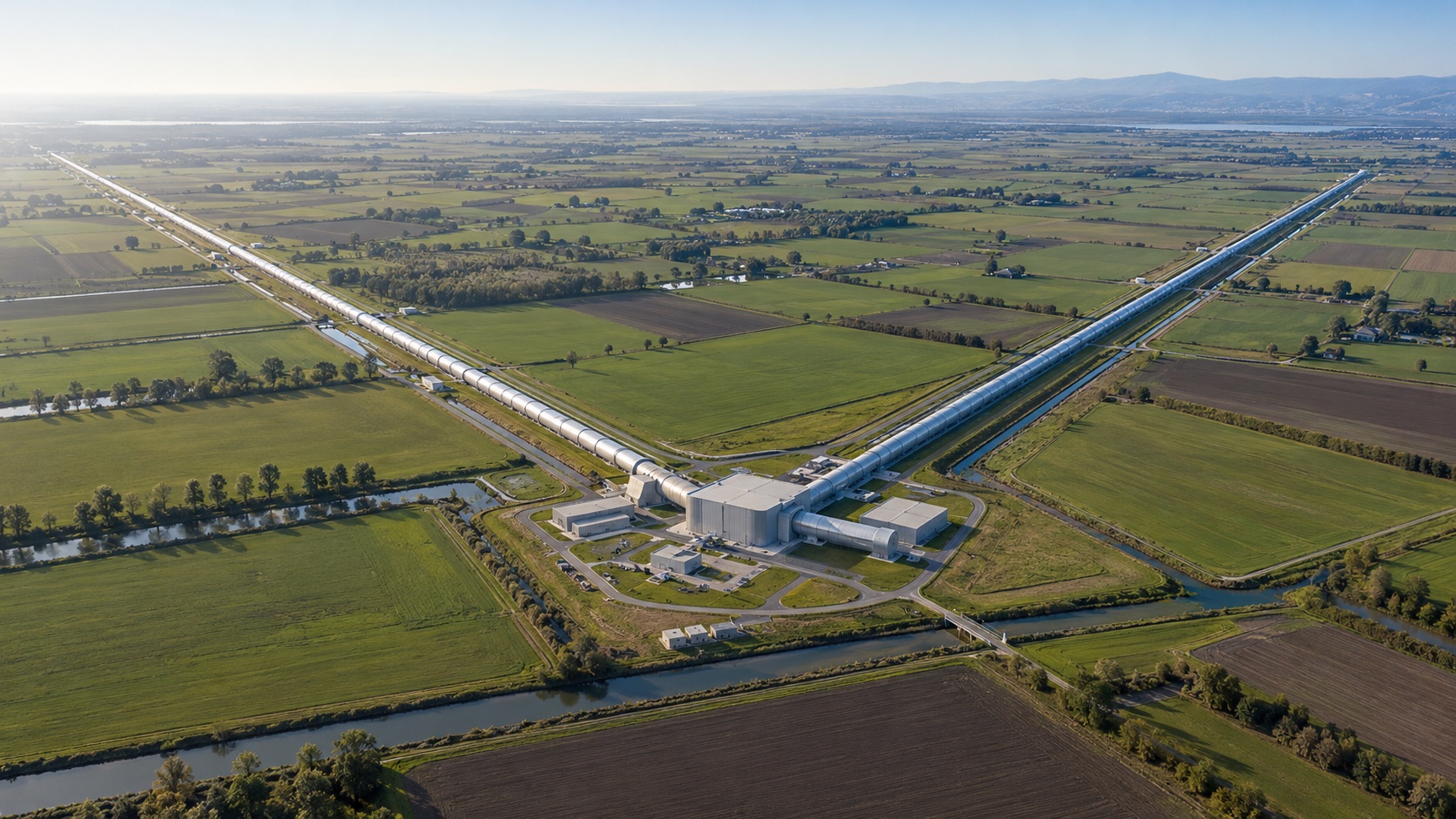
For almost all of human history, astronomy meant collecting light. Europe helped add another sense. The Virgo detector at Cascina, near Pisa, listens for gravitational waves: minute ripples in space-time from black holes and neutron stars accelerating and merging far across the Universe. It does not make this new astronomy alone. Its European achievement is to give a global network a distinct, exquisitely measured ear—and therefore a much better way to work out where a signal came from.
From a French-Italian idea to a European laboratory
Virgo began as a French-Italian idea. Physicists Alain Brillet and Adalberto Giazotto developed the concept in the late 1980s; France's CNRS and Italy's INFN approved the project in 1993, construction began in 1997 and the European Gravitational Observatory was founded in 2000 to host and operate the site. The Netherlands' Nikhef later joined the institutional effort, while universities and laboratories across Europe contribute scientists, engineers, technicians, software, analysis and detector development.
How a three-kilometre interferometer hears space-time
The machine is monumental because the effect is almost impossibly small. A laser beam is split down two perpendicular vacuum arms, each three kilometres long. Mirrors send the light back so the beams can be recombined. A passing gravitational wave stretches one arm while shrinking the other, changing the interference pattern. Virgo describes the measured displacement as roughly one thousandth of a proton's diameter. Making that difference visible requires vacuum systems, extremely pure optics, stable lasers, control electronics and a continuous campaign against noise.
Earth is loud at this scale. Seismic motion, traffic, weather, thermal motion in mirrors and suspension fibres, laser fluctuations, electronics, residual gas and even quantum behaviour of light can bury the astrophysical signal. Virgo's ten-metre-scale superattenuator suspension towers isolate its mirrors through chains of inverted pendulums and filters. Optical cavities make the laser travel the arms repeatedly, increasing the effective interaction. Environmental sensors and data-quality systems help researchers distinguish a cosmic event from a local disturbance.
Upgrades, commissioning and honest engineering
That engineering culture is as important as the concrete arms. The detector has repeatedly been rebuilt into a more sensitive instrument: initial Virgo, Advanced Virgo and Advanced Virgo Plus. Each upgrade is followed by commissioning, when thousands of coupled systems must be made stable together. The setbacks are part of the achievement. Virgo delayed its first entry into the fourth observing run while teams replaced and retuned delicate optical components rather than claim sensitivity the instrument had not yet reached.
Why the third detector changed the sky map
Virgo's first gravitational-wave detection on 14 August 2017 showed exactly why Europe mattered. The two US LIGO instruments and Virgo observed the black-hole merger GW170814 together. Adding Virgo reduced the event's 90% credible sky area from 1,160 square degrees with the two LIGO sites to 60 square degrees in the full analysis. A third detector, separated by an ocean and oriented differently, turned a broad swathe of sky into a far more useful search region and opened new tests of gravitational-wave polarisation.
Three days later came the defining multi-messenger event GW170817, a merger of two neutron stars. Virgo did not register a strong signal because the source lay near a direction to which the detector was relatively insensitive. That apparent absence was scientifically powerful: combined with the LIGO detections, it sharply constrained the position. Telescopes found light from the merger, allowing astronomers to connect gravitational waves, gamma rays and the production of heavy elements. A detector network learns from both a signal and a well-understood non-detection.
A European instrument inside a global network
The network is the real observatory. Virgo shares data and scientific analysis with the two LIGO instruments in the United States and KAGRA in Japan. Timing differences, signal strength and each detector's directional response let the collaboration triangulate sources. One instrument can make a detection; several instruments can build a sky map, reject local disturbances, warn telescopes and test the waveform more deeply. Europe did not replace American or Japanese capability—it made the worldwide instrument substantially better.
The 2026 catalogue and a six-square-degree record
That contribution is visible in the newest catalogue. GWTC-5, released in May 2026, added 161 events from April 2024 through January 2025 and brought the validated total reported by the collaboration to 390. The signal GW240615, observed by the two LIGO detectors and Virgo, was localized to just six square degrees—the most precise gravitational-wave sky localization reported at the time. Virgo had rejoined the observing campaign in April 2024, and its continental baseline was decisive to that record.
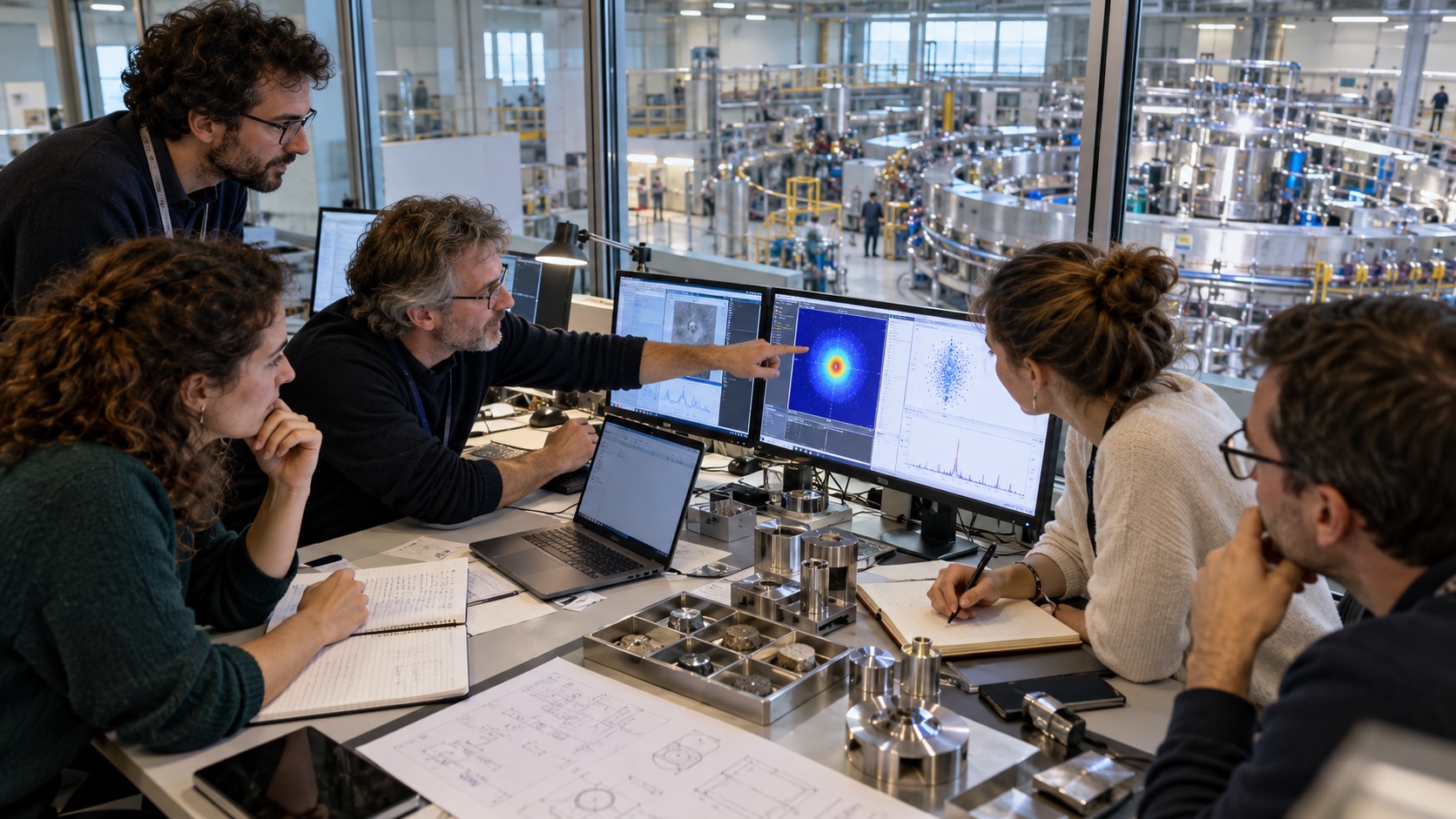
The catalogue is not merely a scoreboard of collisions. Hundreds of events let scientists study how black holes form, search for second-generation mergers, test general relativity where gravity is extreme and estimate the expansion rate of the Universe through a method independent of traditional distance ladders. The same release included the clearest gravitational-wave signal yet reported and a Hubble-constant estimate more precise than the collaboration's previous catalogue, while still not precise enough to settle the existing cosmological tension.
Open data and a distributed scientific community
Europe also helped make this astronomy open. Calibrated LIGO, Virgo and KAGRA strain data, event catalogues, quality information and tutorials are released through the Gravitational Wave Open Science Center. The O4b release includes data from LIGO Hanford, LIGO Livingston and Virgo at original and downsampled rates. A student or research team anywhere can inspect the same time series used to find and characterize events, test a method or teach signal analysis without owning a three-kilometre instrument.
The scientific collaboration is deliberately wider than the host institutions. Researchers, engineers, technicians and students from many European institutes work on the hardware, controls, calibration, computing, noise hunting and astrophysics. In 2026 EGO and the collaboration created VirgoLab as a distributed laboratory to organize operation, maintenance, commissioning and upgrades. This is how big science becomes a durable European capability rather than one national facility with visiting users.
What is operating, planned and still difficult
The current moment requires accurate language. On 16 October 2026, Virgo, LIGO and KAGRA were in an upgrade and commissioning period, not a full observing run. The collaboration's plan updated on 15 October targeted a six-month Intermediate Run 1 beginning in mid-January 2027, with LIGO and Virgo participating and KAGRA joining later as available. O5 remained under discussion. Engineering data can still generate a public alert for an exceptional event, but a projected run is not an operating campaign.
Virgo also remains less sensitive than the two LIGO sites across important parts of the band, and difficult commissioning has delayed planned gains. Its scientific value is not reducible to being the furthest-listening individual detector. Geometry matters: even a quieter or less sensitive instrument can transform localization when it contributes reliable information from a different place and orientation. The next test is to raise sensitivity and observing time while preserving calibration, stability and rapid public alerts.
Future European gravitational-wave ambition extends beyond Virgo. The proposed underground Einstein Telescope would be a third-generation European observatory, while space missions will eventually listen at very different frequencies. Those projects are not completed achievements and should not be borrowed to inflate today's record. Virgo's case is already strong: Europe conceived, built, upgraded and sustained the continent's only operating large gravitational-wave interferometer and made a global scientific network more capable than any member alone.
The federal lesson: one precise part of a greater whole
This is European pride in its most convincing form. France and Italy began with a nearly absurd measurement problem; laboratories across a continent learned to solve optics, vacuum, vibration, quantum noise, control and data challenges together; international partners turned separate detectors into one planetary instrument. Virgo lets humanity locate invisible collisions billions of light-years away because Europe chose to build one precise, patient piece of a larger whole.