Europe's shared forecast behind the national weather map
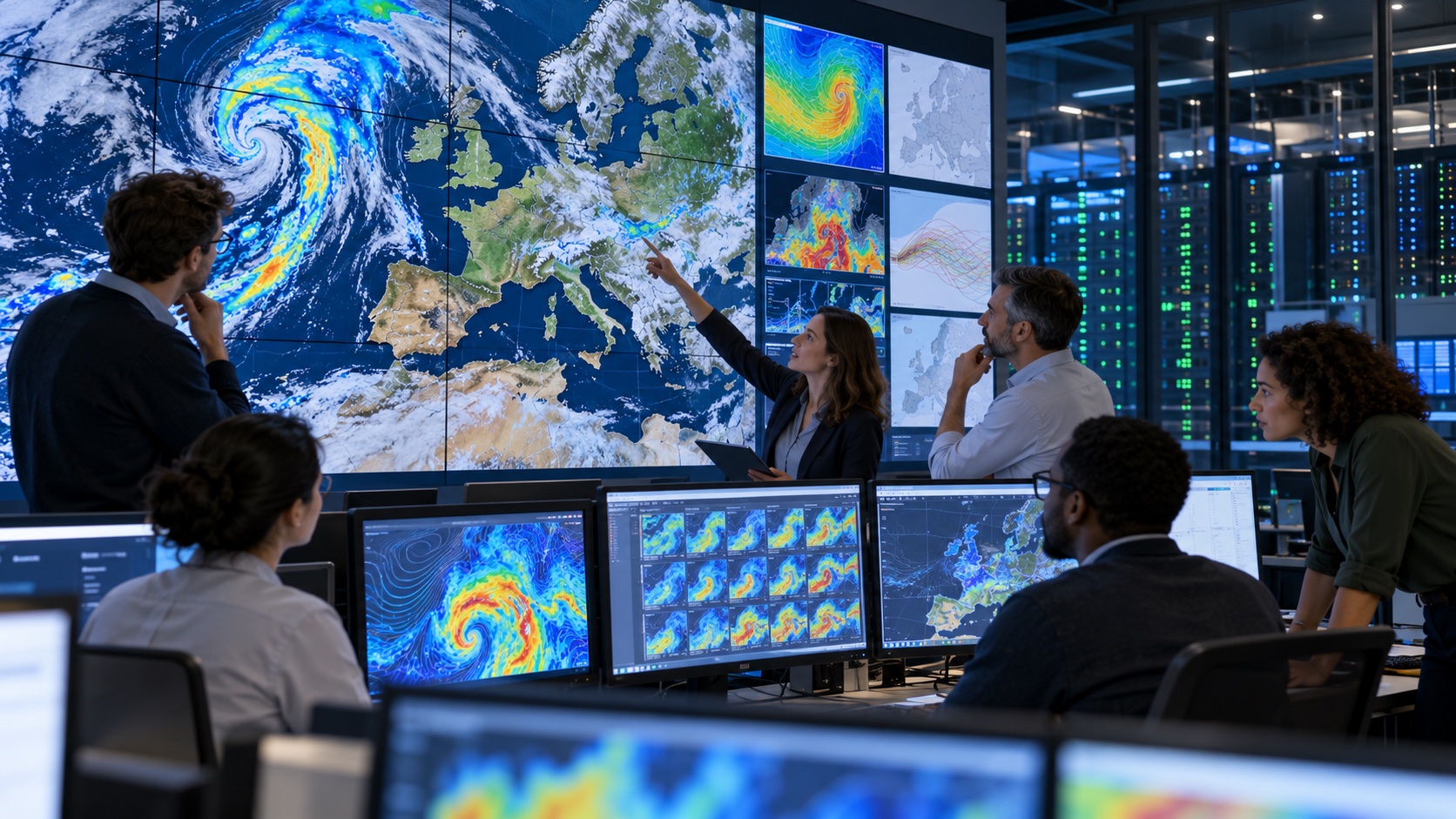
A weather map may carry a national broadcaster's colours, but much of the numerical evidence behind it begins as a European common good. The European Centre for Medium-Range Weather Forecasts—ECMWF—combines observations, mathematics, Earth-system science, supercomputers, machine learning and continuous verification so national meteorological services do not each have to recreate a global forecasting centre alone. Europe can be proud of the result: fifty years after its creation, a shared institution works around the clock to make uncertainty more visible before weather becomes impact.
Fifty years of intergovernmental capability
ECMWF is wider than the European Union and is not an EU agency. It is an independent intergovernmental organisation created in 1975. Its first operational medium-range forecast followed in 1979, operational ensemble prediction in 1992 and the first ECMWF reanalysis in 1993. In 2026 it is supported by 35 states: 23 Member States and 12 Co-operating States. Council representation, state contributions, national expertise and a permanent professional centre turned an ambitious research compact into durable infrastructure.
The division of labour is one of the achievement's strengths. National meteorological and hydrological services know local terrain, warning chains, language and public responsibilities. ECMWF supplies global numerical prediction, research, common software, archive access, training and computing. Member and Co-operating States receive the Centre's prediction data in real time; Member States can also use part of its supercomputing capacity. The common centre strengthens national services rather than replacing them.
From observations to an ensemble of possible futures
Forecasting starts with a problem no country can solve by looking only at its own sky. The atmosphere and ocean cross borders continuously. Satellites, aircraft, ships, buoys, radar and ground stations produce observations with different coverage and error. ECMWF data assimilation combines those observations with a previous forecast to estimate the current state of the Earth system. Models then calculate many possible evolutions of atmosphere, land, ocean, sea ice and waves across time.
An ensemble is central because one deterministic line would hide the uncertainty that matters most. ECMWF perturbs starting conditions and model behaviour to create a range of plausible outcomes, letting forecasters assess probabilities and low-likelihood severe scenarios. A 20% risk of destructive rain is different from certainty, but it may still justify readiness. The shared European achievement is not a machine that is never wrong; it is a disciplined system that measures, tests and communicates how wrong a forecast might be.
Physics, AI and published forecast skill
The Integrated Forecasting System remains the physics-based operational core, while Europe has added a second technological path. AIFS Single became operational in February 2025 and the AIFS ensemble followed in July 2025. ECMWF's 2025 performance assessment found the AI systems had superior skill for most upper-air and surface parameters compared with the corresponding IFS control and ensemble forecasts. The same assessment records the boundary honestly: ECMWF does not lead every centre for every short-range surface variable, and precipitation remains difficult. Europe built a culture of published verification rather than a marketing claim of perfect weather knowledge.
That verification culture is a strategic asset. ECMWF tracks headline scores, publishes annual technical evaluations and listens to the technical advisory body formed by participating services. A major model upgrade in late 2024 improved medium-range upper-air ensemble scores and reduced large northern-extratropical errors in two-metre temperature and ten-metre wind by about 10%, while precipitation gains were much smaller. Reporting both kinds of result is how a public forecasting system earns trust and finds its next research problem.
Supercomputing, archives and ERA5
The computing is continental industrial infrastructure in its own right. ECMWF's high-performance computing and data centre is in Bologna, with headquarters in Reading and additional activity in Bonn. Forecast cycles must ingest observations, run complex models, create ensembles, archive output and disseminate products on deadlines that weather will not postpone. Specialist software and the European Weather Cloud help users bring analysis close to large datasets instead of moving everything repeatedly across networks.
The archive is as important as the next forecast. ERA5, the fifth-generation ECMWF reanalysis, reconstructs past weather and climate by applying a consistent model and data-assimilation system to historical observations. Reanalysis cannot turn sparse early observations into perfect truth, and later periods are usually better observed. Its value is consistency: researchers, planners and services can examine storms, heat, wind, water and climate variables through one documented global record rather than stitching together incompatible snapshots.
Open data at operational scale
ECMWF has also become a public data institution. Open Data and charts expose selected real-time forecast products, while ERA5 and other public datasets are available through managed stores. Access remains tiered: participating national services receive the full operational relationship, some tailored products require agreements and not every archive product is open without conditions. The direction, however, is clear. The 2025 annual report records the opening of the full real-time catalogue under a permissive licence, and the shared Data Stores Service now supports a much wider community.
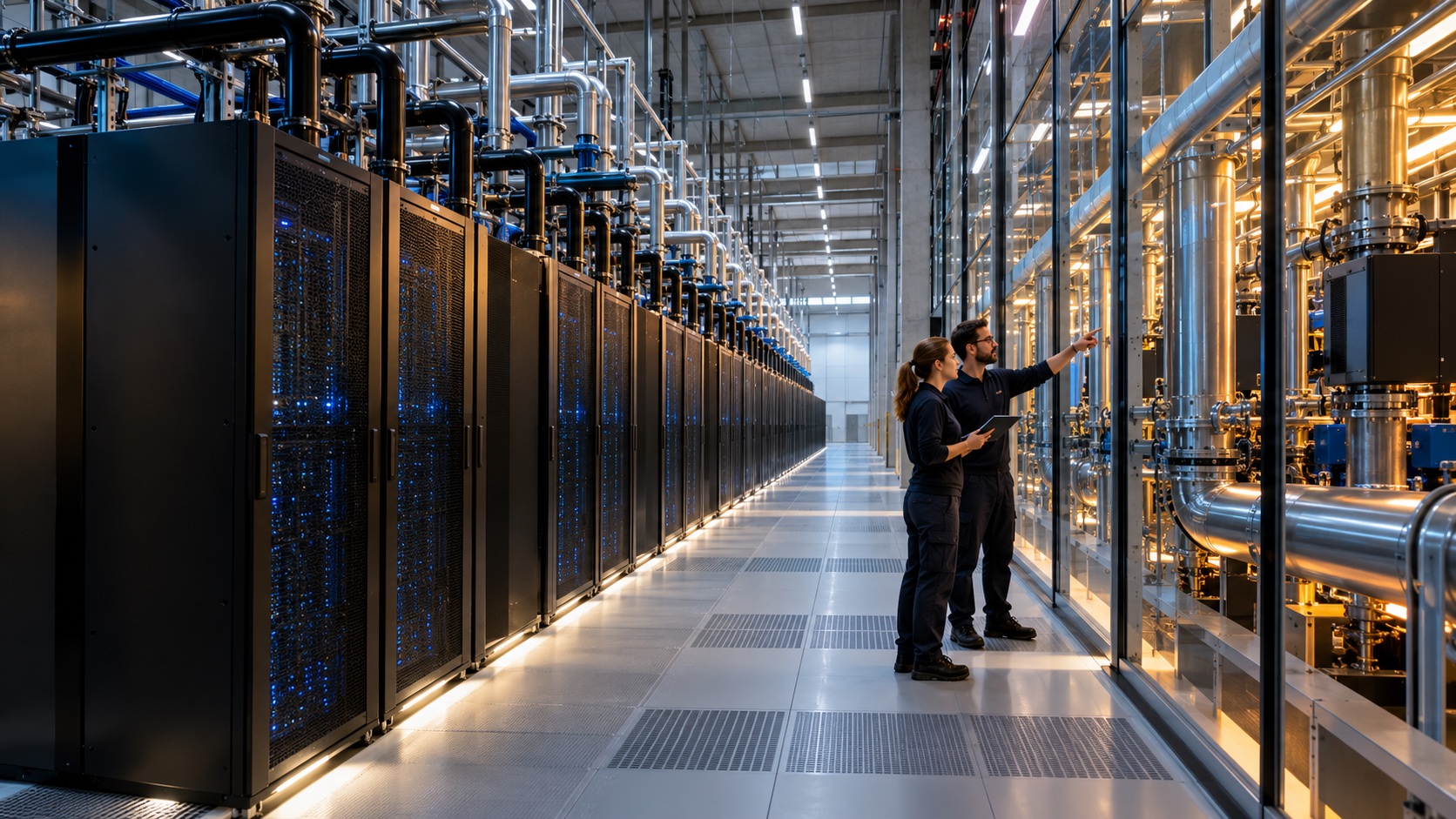
The scale of that use is concrete. ECMWF reported in 2026 that its Data Stores Service supported more than 7,500 active users a day, around half a million daily requests, roughly 100 terabytes delivered per day on average and more than 280,000 registered users. The service provides one operational backbone for the Copernicus Climate, Atmosphere and Emergency data stores and the ECMWF Data Store. European investment reaches universities, public authorities and downstream services through APIs, not only through press releases.
Copernicus and Destination Earth
The Copernicus relationship expands weather prediction into climate and environmental intelligence. On behalf of the EU, ECMWF implements the Copernicus Climate Change Service and Atmosphere Monitoring Service and contributes to flood and fire information in the Emergency Management Service. Climate reanalysis, greenhouse gases, aerosols, air quality, solar radiation, seasonal outlooks, flood awareness and fire danger connect a forecasting institution with health, energy, agriculture, transport and adaptation decisions.
Destination Earth is the next shared layer, not a finished crystal ball. ECMWF, ESA and EUMETSAT are the three entrusted European organisations; ECMWF is responsible for the digital-twin engine and work on twins for weather-induced extremes and climate adaptation. By June 2026 the initiative had entered a third phase after collaboration with more than 100 partner organisations. These systems can explore high-resolution event and climate scenarios, including 'what if' questions, but simulated storylines remain decision evidence rather than guaranteed local outcomes.
One chain from satellite observation to public action
ECMWF and EUMETSAT should not be collapsed into one institution. EUMETSAT operates shared meteorological satellite systems and distributes observations. ECMWF assimilates observations from many sources into models and predictions. The Copernicus programme adds satellites, in-situ data and thematic services under EU governance. Their cooperation is exactly the European accomplishment: separate mandates forming one operational chain from observation to forecast to public action.
Costs, limits and global dependencies
The capability has limits and costs. Supercomputing, data storage and cooling consume energy; models inherit observation gaps and approximations; extreme local rainfall, fog, convection and surface conditions can remain hard; and national warning quality depends on interpretation and communication after the global data arrive. AI systems require training data and can reproduce biases. Open access has expanded but is not uniform. These are responsibilities for the next investment cycle, not reasons to dismiss what has already been built.
Nor is the achievement European because every component or idea originates inside Europe. Forecasting depends on worldwide observations, WMO exchange, international science, global users and computing supply chains. ECMWF's strength is its ability to organise those inputs into a stable European-governed capability, publish its methods and verification, share results and contribute back to global meteorology. Strategic capacity is the power to integrate and operate responsibly, not a fantasy of isolation.
Forecasting as a federal European achievement
Weather prediction is a persuasive federal lesson because atmosphere makes sovereignty's physical limit obvious. No border can keep tomorrow's storm outside, and no small service should have to own a world-scale model stack to protect its citizens. Europe pooled the expensive layer, kept local public services close to people and built institutions for shared governance, expert challenge and continuous improvement. The Proud Europe hub follows achievements like this because they show that being European already means inheriting capabilities no country had to build alone.
Europe should be proud of ECMWF not because every forecast verifies, but because Europeans created the machinery for learning from every miss. Observations become analyses, models become ensembles, forecasts become measurements of skill, archives become climate knowledge and national services turn shared evidence into warnings in their own languages. That is integration at its most mature: technically demanding, publicly useful, honest about uncertainty and present every day before most citizens know its name.