Europe built a network, not one giant control tower
Europe can be proud of EUROCONTROL because a flight from Lisbon to Helsinki does not meet a new aviation system at every border. Controllers remain national in most airspace, airports and airlines make their own operational decisions, and sovereignty has not disappeared. Yet flight plans, capacity, routes, delays, weather risks, military constraints and common data are coordinated as one network. That quiet layer of shared capability is what lets thousands of cross-border journeys become ordinary.
The institution predates the European Union in its current form. Six countries signed the EUROCONTROL Convention in 1960 as civil jet traffic made nationally isolated air-traffic management increasingly impractical; the Convention entered into force in 1963. The organisation now has 42 member states and two Comprehensive Agreement States, Israel and Morocco. Its reach is wider than the EU, which matters because safe routes and traffic flows follow geography rather than institutional membership.
EUROCONTROL is not an EU agency and it should not be confused with the European Union Aviation Safety Agency. Member states created it by international convention and fund much of its work. At the same time, the European Commission appointed EUROCONTROL to perform the EU Single European Sky's Network Manager role for 2020–2029. Intergovernmental expertise and Union law therefore meet inside one operating arrangement rather than competing from separate rooms.
How the Network Manager coordinates a flying day
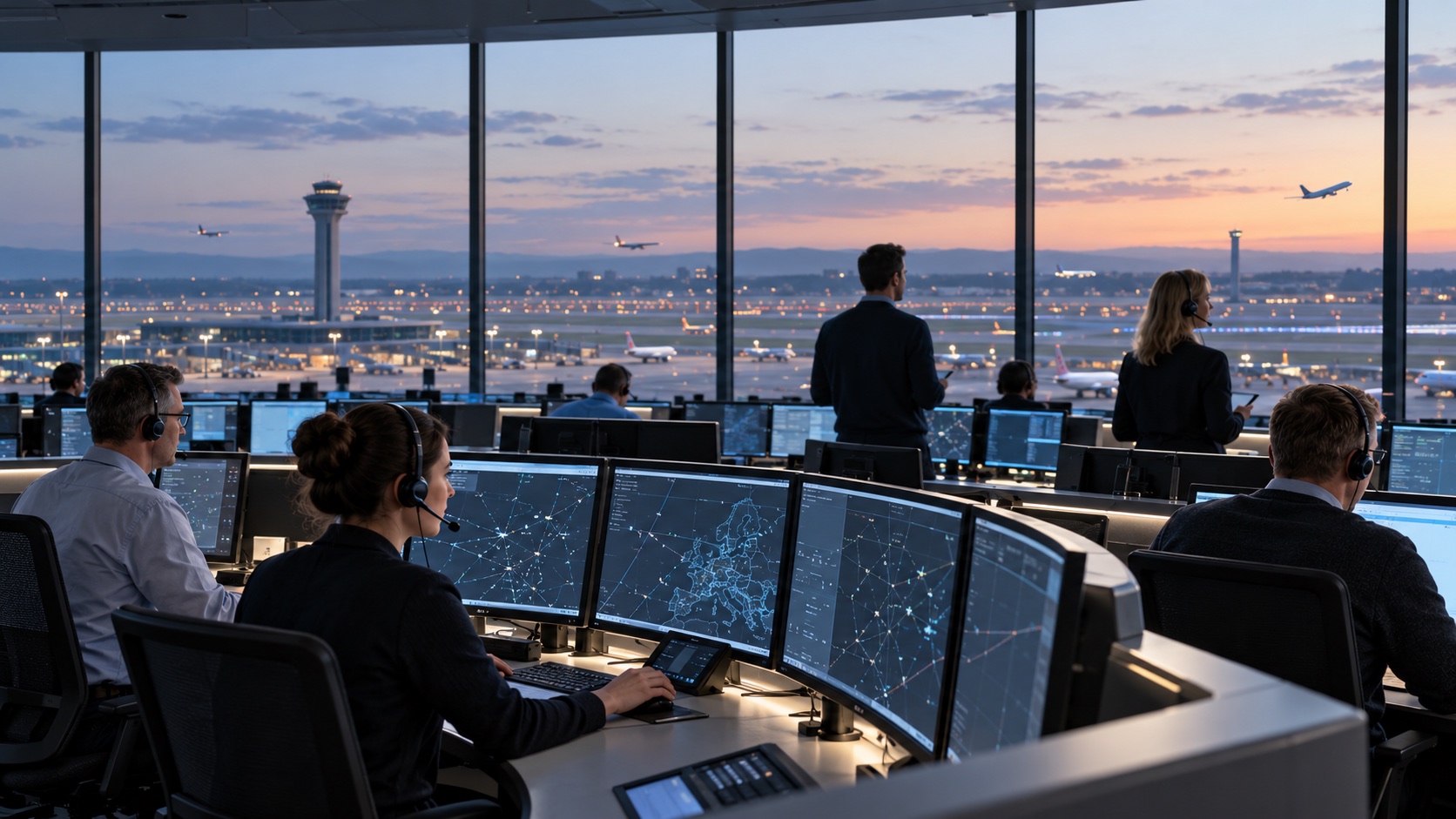
The Network Manager's daily task is to see the system that no airport, airline or national control centre can see alone. Its Brussels operations centre receives flight plans and shared airspace data, monitors traffic and capacity, identifies bottlenecks and coordinates measures with airlines, airports, national air-navigation providers and civil and military authorities. A local decision can move delay hundreds of kilometres away; network management makes those consequences visible before each actor optimises only its own corner.
This is coordination, not remote control of every aircraft. The national or regional air-traffic control unit remains responsible for separation in its airspace. EUROCONTROL helps decide how demand should meet available capacity, validates flight planning, proposes reroutes, manages flow measures and calculated take-off times, and shares a common operational picture. That distinction is important: Europe built a continental nervous system without pretending every operational hand belongs to one body.
The scale is substantial. EUROCONTROL's Network Manager reported that European traffic exceeded its pre-pandemic level in 2025, averaging more than 30,000 flights a day. Safety targets were achieved, delays fell from 2024 and punctuality improved even while Ukrainian airspace remained closed, military activity increased, some areas lacked capacity and disruptive weather became more frequent. One good annual result does not mean delay disappeared; it shows a shared network responding under pressure.
Shared data and free-route airspace
Flight planning depends on common data before a slot is ever discussed. EUROCONTROL collects aeronautical information, maintains airspace and capacity databases, and operates systems that validate and distribute flight plans. Airlines and control centres need the same understanding of route availability, restrictions, sectors, airports and timing. A corrupted point or incompatible plan is not merely clerical: it can waste scarce capacity or create an operational risk far from where the error began.
Europe has also redesigned how routes can be planned. Free Route Airspace allows an operator to plan between defined entry and exit points without being forced along the old fixed route network, while flights remain under air-traffic control. EUROCONTROL developed the common concept with states, civil and military experts, navigation providers and users. Its published data show airspace-design route extension falling from 3.58% in December 2007 to 1.57% in August 2025, partly through this work and despite major disruption.
The benefit is not only time. A shorter or more flexible route can reduce fuel, emissions and cost while giving the network more options. EUROCONTROL estimates that complete free-route improvements could avoid enormous cumulative distance, fuel and carbon compared with the older structure, but those are projected system benefits rather than emissions already erased. Real savings depend on traffic, weather, military availability, airline choices and cross-border implementation.
Maastricht: four countries controlled together
The Maastricht Upper Area Control Centre is the clearest physical example of shared sovereignty in operation. EUROCONTROL controllers directly manage upper-airspace traffic over Belgium, the Netherlands, Luxembourg and north-west Germany for civil and military users. The centre grew from a 1964 agreement among four countries and remains the one planned multinational upper-area centre that became a lasting operational reality. It proves that shared control can be literal, not only a coordination meeting.
In the May-to-October 2025 summer period, Maastricht handled an average 5,295 flights a day and set a daily record of 5,831 flights on 4 July. Its work includes cross-border free-route operations, controller-pilot data links, civil-military coordination and airspace redesign with neighbouring centres. The achievement is not the record for its own sake. It is that four states trust one international centre to run a safety-critical public service across their upper airspace every day.
One route-charge bill and shared technical resources
Money crosses the same borders as the flights. EUROCONTROL's Central Route Charges Office calculates, bills and collects route charges on behalf of states so that an aircraft operator receives one monthly bill in euros no matter how many participating member states it overflew. The revenue funds air-navigation facilities and services. This is unglamorous European infrastructure at its best: one administrative interface replaces a stack of separate national invoices while states still receive the money due for their services.
Network functions also manage scarce shared resources. Radio frequencies and aircraft transponder codes cannot be assigned as though neighbouring skies were unrelated. EUROCONTROL coordinates frequency use and operates centralised code-assignment services, reducing conflict and using limited ranges more efficiently. These technical details rarely reach a passenger, but the system depends on them in the same way a railway depends on interoperable signals rather than only visible trains.
Crisis, weather and industry connect to the network
Crises make the network layer visible. Volcanic ash, severe weather, cyber incidents, airspace closures, strikes, conflict and public-health disruption can reshape traffic across many states at once. The Network Manager brings operational actors together and supports the European Aviation Crisis Coordination Cell so information, scenarios and mitigation can be shared. That role complements the EU Civil Protection Mechanism: one reinforces disaster response on the ground, while the other keeps aviation decisions connected.
Weather coordination links this story to another European achievement. EUMETSAT, national meteorological services and forecasting centres produce the observations and warnings; EUROCONTROL and aviation actors turn that evidence into capacity and route decisions. The Proud Europe EUMETSAT feature explains the upstream satellite system. Together they show why public capability is a chain: observation has value when institutions can act on it together.
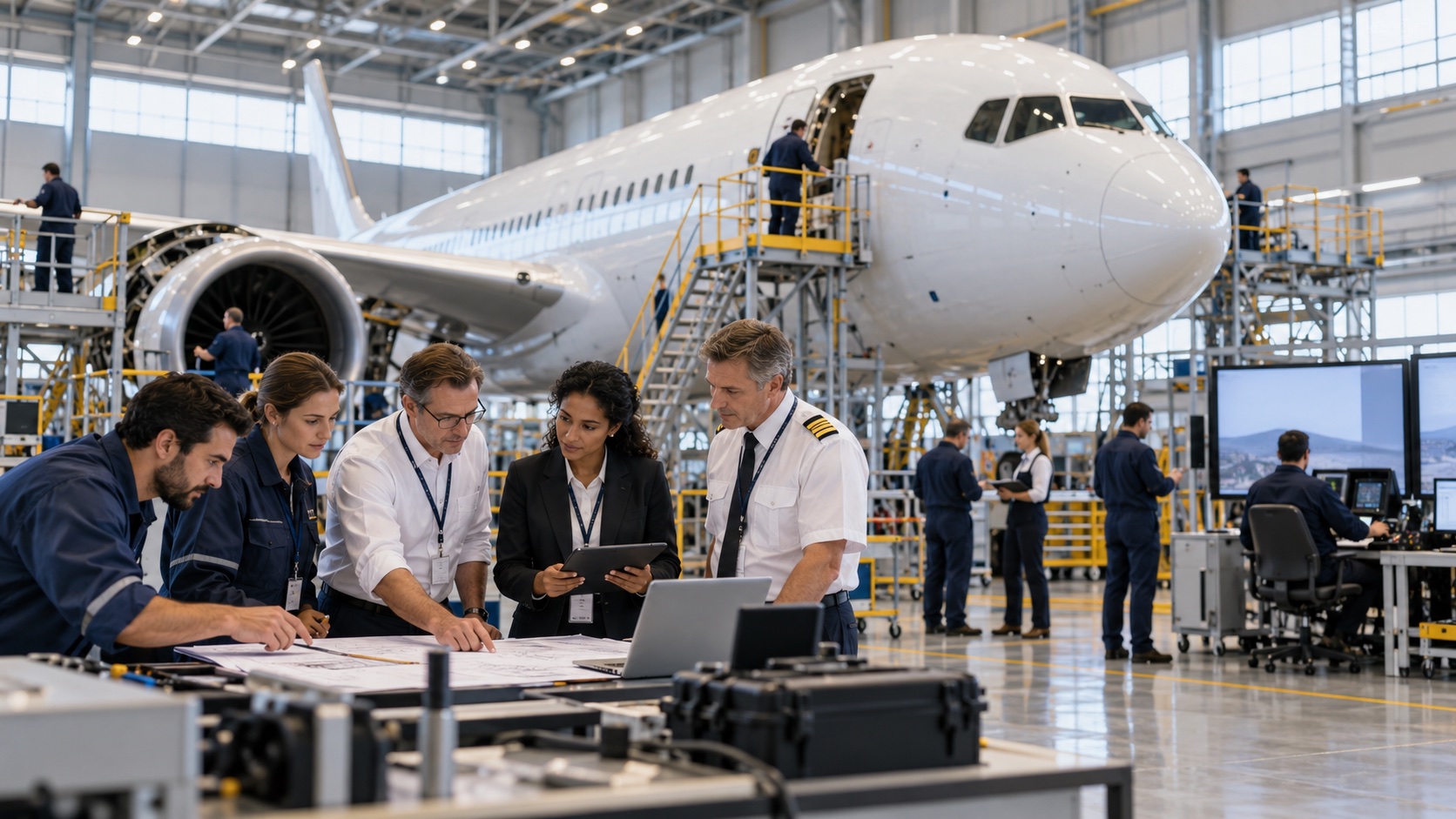
Industry belongs in the chain too. The Airbus story is about designing and building aircraft across borders. EUROCONTROL's story is about the shared operational environment in which aircraft from every manufacturer and airline can use European airspace. Common procedures, performance data, network plans and modernisation projects help new cockpit systems, digital services and airspace concepts work beyond a single vendor or country.
The Single European Sky is still unfinished
The Single European Sky remains unfinished. National airspace structures, procurement, staffing, military needs and control-centre boundaries still fragment capacity. Summer bottlenecks can produce serious delay, and rerouting around war or restricted areas makes efficient paths harder. Technology modernisation through the integrated Network Manager programme and SESAR must deliver working operational tools, not only strategies. Accountability also has to stay legible when responsibility is shared among the Commission, EUROCONTROL, states, navigation providers, airports and users.
That context does not diminish what already works. The Network Management Board gives navigation providers, airspace users, airports and military representatives formal roles in oversight, while the Commission and states remain involved under the Single European Sky framework. The arrangement is complex because the network itself is complex. The democratic task is to make responsibilities and performance easier for the public to follow, not to pretend that fragmentation is a safer default.
Passengers experience the output indirectly. A calculated slot, a reroute around storms, a validated flight plan or a better-designed cross-border route can prevent or reduce disruption, but it does not replace airline obligations when a journey still fails. Federal Europa's flight-delay guide explains care, refunds and compensation. Operational coordination and passenger rights are two parts of the same European promise: prevent avoidable disruption, then give people a fair remedy when prevention is not enough.
A federal lesson above national borders
EUROCONTROL offers a particularly honest federal lesson. Europe does not need one institution to own every radar, employ every controller or make every local decision. It needs common data, rules, planning, financing, operational coordination and authority at the scale where cross-border effects occur. National expertise can remain close to the airspace while a European layer protects the performance of the whole network.
The next test is demanding: more traffic, climate pressure, drones, space launches, digital dependence, cyber risk, military activity and extreme weather must fit into finite airspace. Success should be measured in safety, delay, flight efficiency, resilience, emissions and transparent responsibility—not in institutional slogans. Europe begins that test with six decades of cooperation, a live operations centre, one multinational control centre and a network used tens of thousands of times each day.
That is why EUROCONTROL belongs in Proud Europe. Europeans built the habit and machinery of seeing their sky as a shared system. The work is technical, continuous and mostly invisible, which is precisely what makes it an achievement: cooperation has become dependable enough that millions of people can look up, board a flight and assume the continent above them already knows how to work together.