Forty years of shared European fusion
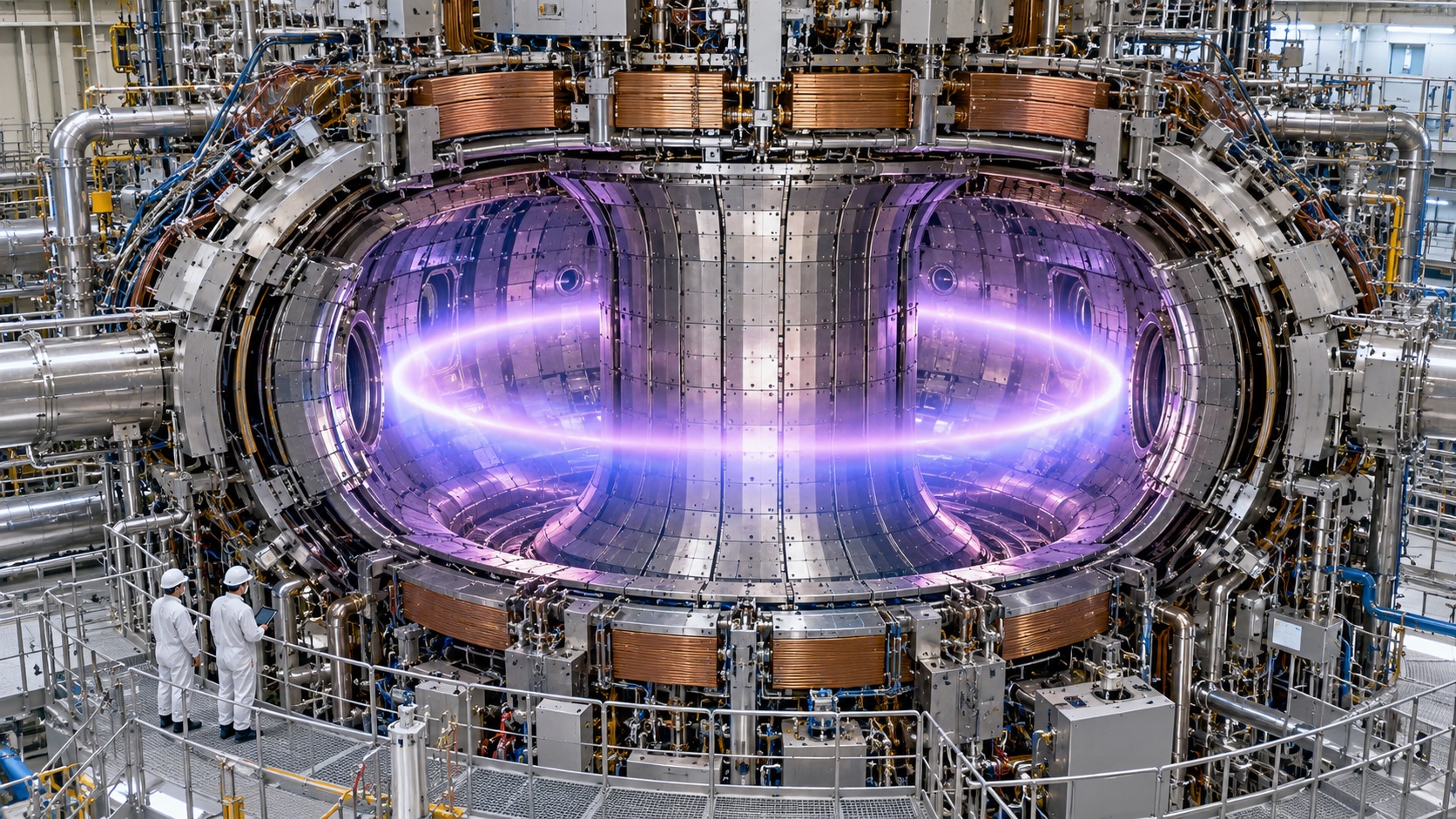
Europe built a machine that held matter ten times hotter than the centre of the Sun and made it useful to a continent. The Joint European Torus, or JET, began plasma experiments in 1983 at Culham in the United Kingdom. On 18 December 2023, pulse 105,842 ended four decades of operation. Between those points, European laboratories turned one tokamak into a shared test bed for fusion fuel, materials, control, neutron effects, remote maintenance and the researchers who will operate later machines.
A 69.26-megajoule final record
JET's final campaign left a fitting result. In one deuterium-tritium pulse, the machine released 69.26 megajoules of fusion heat over about five seconds, with average fusion power around 12.4 megawatts. It surpassed JET's 59-megajoule result from 2021 and remains the record for total fusion energy from a magnetic-confinement experiment. The number matters because the pulse used the fuel and metal-wall conditions relevant to future tokamak reactors, not because 69 megajoules would transform an electricity grid.
The honest boundary strengthens the achievement. JET consumed much more energy in heating, magnets and supporting systems than the plasma released through fusion; a 2025 analysis reports an average plasma gain of about 0.36 for the record pulse. The machine had no equipment to turn fusion heat into electricity and was never designed as a commercial reactor. It demonstrated controllable fusion performance and reactor-relevant behaviour, not net power or a finished energy source.
How JET confined and measured a plasma
A tokamak confines a plasma in a doughnut-shaped vacuum vessel with magnetic fields. JET could carry plasma currents up to five mega-amperes within roughly 90 cubic metres, while auxiliary systems supplied tens of megawatts of heating. Around 100 diagnostics could capture up to 18 gigabytes of raw data from a pulse. The experiment combined enormous physical scale with millisecond control and measurements of particles, radiation, temperature, density, instabilities and wall interaction.
Deuterium, tritium and the ITER-like wall
Its distinct advantage was fuel. Deuterium is a stable isotope of hydrogen; tritium is radioactive and must be handled, recovered and accounted for carefully. Their fusion is the leading fuel reaction planned for ITER and many future power-plant concepts. JET became the first machine to produce significant controlled power from a deuterium-tritium plasma in 1991. In 1997 it reached 16.1 megawatts of peak fusion power and a plasma gain near 0.64, records that shaped confidence in the tokamak path.
Europe then changed the machine rather than freezing a successful design. Between 2009 and 2011 JET replaced its carbon-facing interior with an ITER-like wall using beryllium in the main chamber and tungsten in the divertor, the region that exhausts heat and particles. That upgrade sacrificed some familiarity in order to test harder questions about fuel retention, impurities and heat on the materials planned for ITER.
Difficult plasma physics became useful evidence
The metal wall made performance more difficult. Tungsten contamination can radiate energy and cool the plasma core; the final high-power pulses still faced progressive core radiation. Researchers learned to slow that degradation and sustain higher output through the target period, but they did not make the instability disappear. This is what useful experimental infrastructure does: it exposes the limitation in a controlled, measured way before a much larger machine inherits it.
JET also informed decisions beyond a headline energy record. Experiments explored heat exhaust, plasma instabilities, tritium recovery, alpha-particle heating, neutron effects on electronics and cooling systems, disruption mitigation and the behaviour of a tungsten divertor. ITER credits JET evidence with informing its strategy to install a tungsten divertor from the beginning. A result can matter even when it is a constraint, failure mode or maintenance lesson rather than a new maximum.
A European institution built around one machine
The machine itself was European institution-building in metal. JET began as a Euratom joint undertaking, was hosted and operated at Culham, and later worked as a user facility coordinated through European fusion arrangements and EUROfusion. More than 31 European laboratories collectively used the facility, with hundreds of scientists and engineers contributing to campaigns. UKAEA became the owner in 2021 and remained responsible for the site and operation, while the programme preserved continental scientific access after the United Kingdom left the EU.
That governance distinction matters. JET was built by Europe and heavily supported through Euratom and European collaboration, but its final legal ownership was British and its research community extended beyond the EU. Calling it simply an EU reactor would erase the host's role and the wider-European network. The more impressive fact is that sovereign laboratories repeatedly agreed to pool staff, experiments, equipment and scarce machine time around one programme.
Training people and preparing ITER
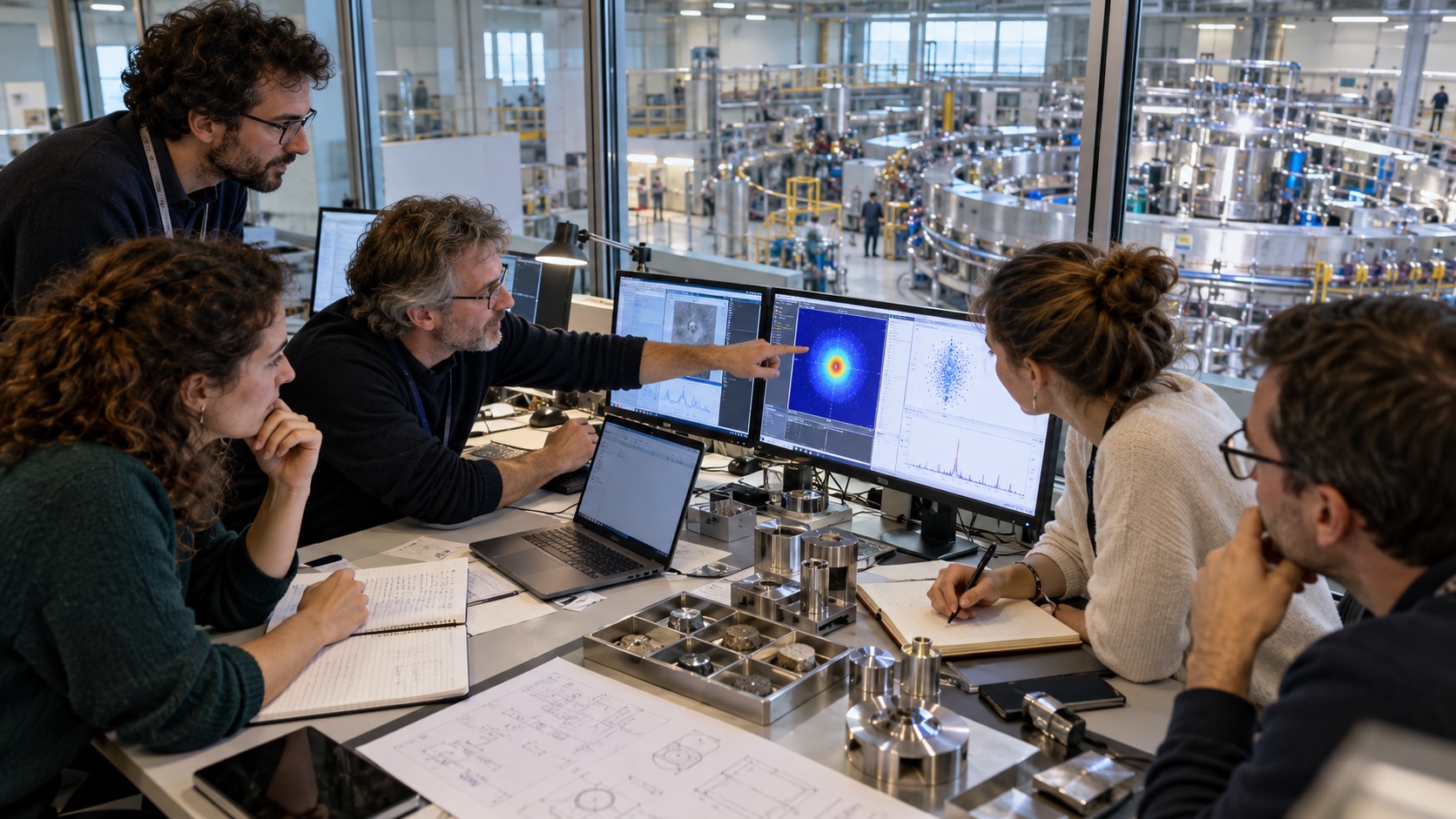
Shared access created a school as well as a device. Generations of physicists, engineers, technicians, control specialists, tritium experts and remote-handling teams learned on JET. More than 300 scientists took part in the final deuterium-tritium programme. When the machine closed, its most portable output was not the last pulse but a community able to design experiments, compare models, operate hazardous fuel systems and recognise when plasma behaviour departs from prediction.
The bridge to ITER is concrete but should not be overstated. JET was often called 'Little ITER' because its geometry, fuel and wall materials let teams test operating scenarios relevant to the much larger international machine under construction in southern France. ITER is a seven-member global project, not a European project alone, though Europe hosts it and supplies roughly half of construction contributions through Fusion for Energy. JET reduced uncertainty; it did not guarantee ITER's schedule or eventual performance.
One experiment inside a broader programme
Europe's fusion programme also extends beyond one lineage. EUROfusion coordinates medium-sized tokamaks such as ASDEX Upgrade, TCV, MAST Upgrade and WEST, while Germany's Wendelstein 7-X explores the stellarator approach. Europe and Japan built JT-60SA through their Broader Approach partnership. A serious strategy needs these complementary machines because plasma confinement, materials, long pulses, maintenance, tritium breeding and economic power conversion cannot all be answered by one device.
JET's record is sometimes compared with other fusion announcements using incompatible measures. Total energy in megajoules, peak power in megawatts, pulse duration, plasma gain, facility-wide energy balance and scientific ignition are different achievements. Laser experiments, tokamaks and stellarators have different inputs and purposes. A responsible comparison states which boundary is being measured before declaring a winner.
Decommissioning is part of the achievement
Decommissioning is now part of the science. Because JET used tritium and energetic neutrons, components can contain radioactive material and retained fuel. UKAEA's programme must characterise, remove, process, reuse or dispose of equipment safely, much of it through remote handling. That work builds knowledge future fusion facilities will need at the end of components and plants. European pride should include responsible dismantling, not end with the final plasma photograph.
Fusion's remaining tests
Fusion still carries profound uncertainties. ITER has experienced delay and redesign; a commercial plant must breed its own tritium, survive sustained neutron damage, exhaust heat, maintain high availability, convert heat efficiently and compete economically with other low-carbon systems. JET answered none of those questions alone. Its final record lasted seconds, and climate policy cannot wait for an uncertain future technology instead of deploying solutions available now.
Why JET is a Proud Europe story
Yet the conclusion is not 'European, but unfinished.' The achievement is that Europe built a durable experimental institution capable of learning for forty years. It modified its own machine to mirror a successor, accepted harder operating conditions, ran the world's most important deuterium-tritium campaigns, published uncomfortable limitations as well as records, and handed the next generation a measured body of evidence rather than a promise.
JET belongs beside CERN and European XFEL as proof that shared European science can build instruments too demanding for routine national duplication. It also connects to EuroHPC: modern experiments become valuable through models, data and computational comparison. The federal lesson is practical—pool the risk, build common capacity, allocate access by scientific value, and let evidence move back to every contributing laboratory.
Europe can be proud of JET because it made the future less hypothetical. The machine did not put fusion electricity on the grid, but it established records, trained a continent, tested the intended fuel, revealed difficult material physics and made an international successor more informed. The Proud Europe hub celebrates that kind of disciplined ambition: a shared institution that can tell the difference between a milestone and a destination, then keep working after the applause.