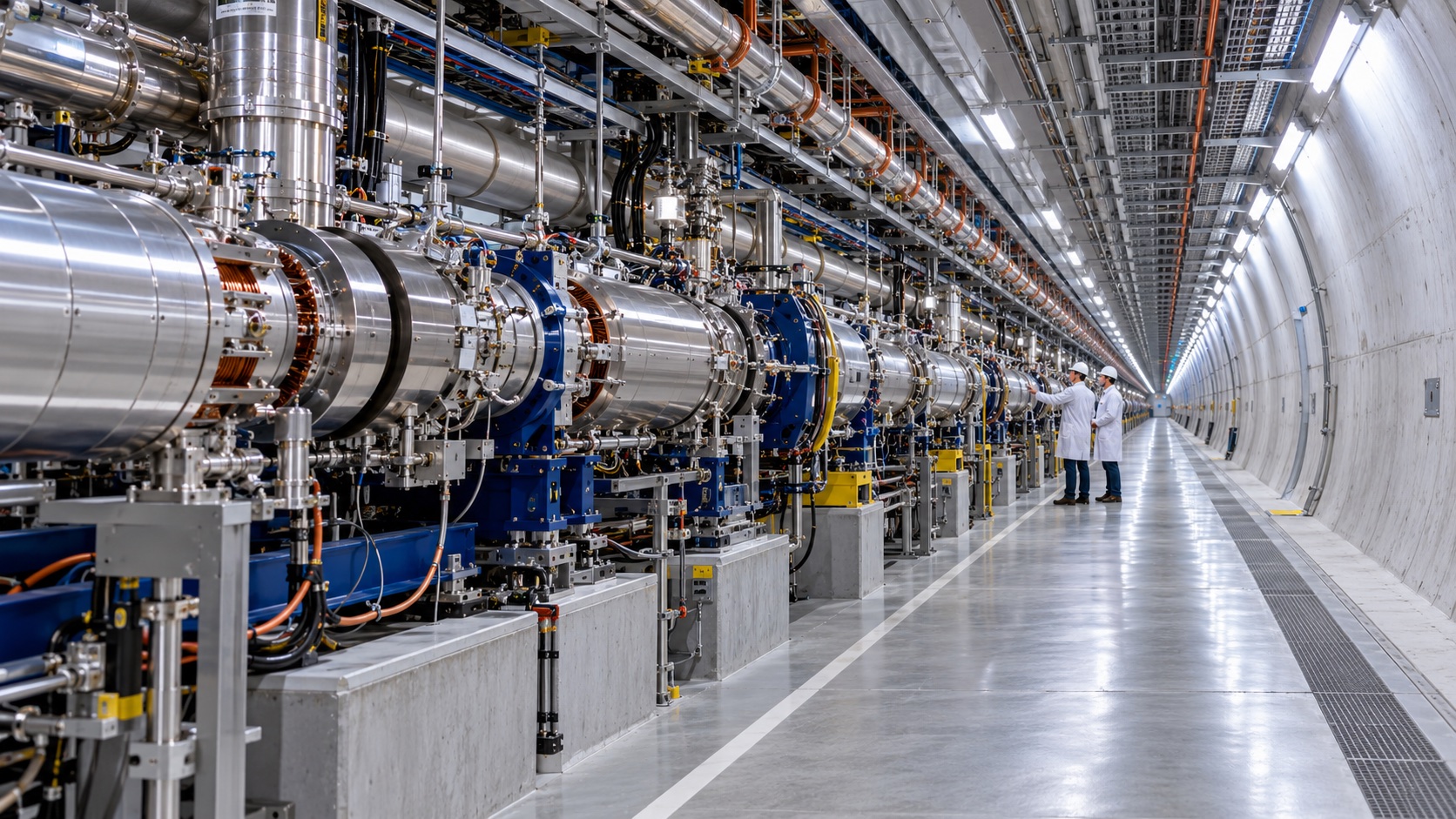
A 3.4-kilometre camera for the atomic world
Europe built a camera for the atomic world. European XFEL sends electrons through a superconducting accelerator and precision magnetic structures to create extraordinarily short, bright X-ray flashes. Those pulses let scientists inspect matter at the scale where proteins fold, chemical bonds change, magnetic states switch and materials behave under pressures like those inside planets.
The facility is physical evidence of what Europe can do together. It runs for 3.4 kilometres from the DESY campus in Hamburg through underground tunnels to an experiment campus in Schenefeld, Schleswig-Holstein. No borderless slogan could substitute for the accelerator modules, cryogenics, vacuum, magnets, optics, detectors, computing, laboratories and trained teams that make the beam usable. Cooperation became concrete, cold, precise and measurable.
Twelve countries built one facility
European XFEL is operated by a non-profit company founded in 2009. Its official current list contains 12 participating countries: Denmark, France, Germany, Hungary, Italy, Poland, Russia, Slovakia, Spain, Sweden, Switzerland and the United Kingdom. Nine are EU members; Switzerland and the UK show the wider European research model, while Russia's continued formal listing is a material governance fact in the context of the war against Ukraine. This is European capacity, not an EU-owned institution and not a claim of political uniformity.
Construction ran from 2009 to 2017 and user operation began in 2017. The official price-level-2005 construction cost was €1.22 billion, with Germany's federal government, Hamburg and Schleswig-Holstein covering 58%, Russia 27%, and the other international partners generally contributing between 1% and 3% each. Europe should be proud of the shared machine while remaining exact about who financed it and how concentrated the original burden was.
How superconducting electrons become X-ray flashes
The core is a 2.1-kilometre superconducting linear accelerator, including 1.7 kilometres of acceleration. Electrons are pushed to as much as 17.5 billion electron volts and almost the speed of light. Ninety-six main accelerator modules, plus two in the injector, contain superconducting cavities cooled with liquid helium to minus 271°C—about two degrees above absolute zero—so electrical current can flow with extremely low resistance.
Acceleration alone does not make the X-ray laser. The electron bunches pass through undulators: long arrangements of alternating magnets that force the particles onto a slalom path. As the electrons turn, they emit X-rays that reinforce one another into intense, laser-like flashes. Beamlines then direct those flashes to specialised scientific instruments, where samples, optical lasers, detectors and timing systems convert raw brightness into a controlled experiment.
Up to 27,000 flashes can be generated each second. Each pulse lasts less than 100 femtoseconds—a femtosecond is one quadrillionth of a second—and the official wavelength range reaches 0.05 to 4.7 nanometres. European XFEL says the peak brilliance is a billion times that of the best conventional X-ray sources. The repetition rate is especially powerful because experiments can collect many observations of fleeting, variable processes rather than relying on one perfect shot.
Seven instruments and peer-reviewed access
That performance supports seven instruments with different jobs. Some study ultrafast chemical reactions and molecular dynamics; some image particles, cells and biomolecules; some probe soft and hard materials; and the High Energy Density instrument combines X-rays with extreme pressure, temperature, fields or optical lasers. A single source becomes many laboratories because the beam can be shaped, timed and measured for different scientific questions.
Access turns the machine from national prestige into shared scientific infrastructure. External researchers submit proposals, instrument teams assess technical feasibility and expert panels review scientific quality. Non-proprietary beamtime is allocated through peer review, while accepted teams receive instrument, laboratory, safety, sample and data support. Competition is unavoidable because high-value beam time is scarce, but a transparent proposal route lets good ideas reach equipment that their home university could never own.
From hundreds of experiments to first-of-kind results
The facility has already become a place of sustained research rather than a ceremonial megaproject. A 2025 operational update recorded more than 11,000 researcher visits, nearly 500 experiments and resulting publications in major journals since user operation began. The publication database lists work by instrument, topic and year, making the scientific record inspectable. Output should be judged by peer-reviewed knowledge, reusable methods and trained people, not by the number of tunnel kilometres alone.
One 2025 result measured the structure of liquid carbon for the first time. Under ordinary pressure carbon changes directly from solid to gas rather than offering an easy liquid phase, so researchers used the DIPOLE 100-X laser with European XFEL's X-rays to create and probe extreme conditions. Liquid carbon matters to planetary interiors and future fusion-related research. The achievement belonged to an international team; the European facility made the otherwise impractical measurement possible.
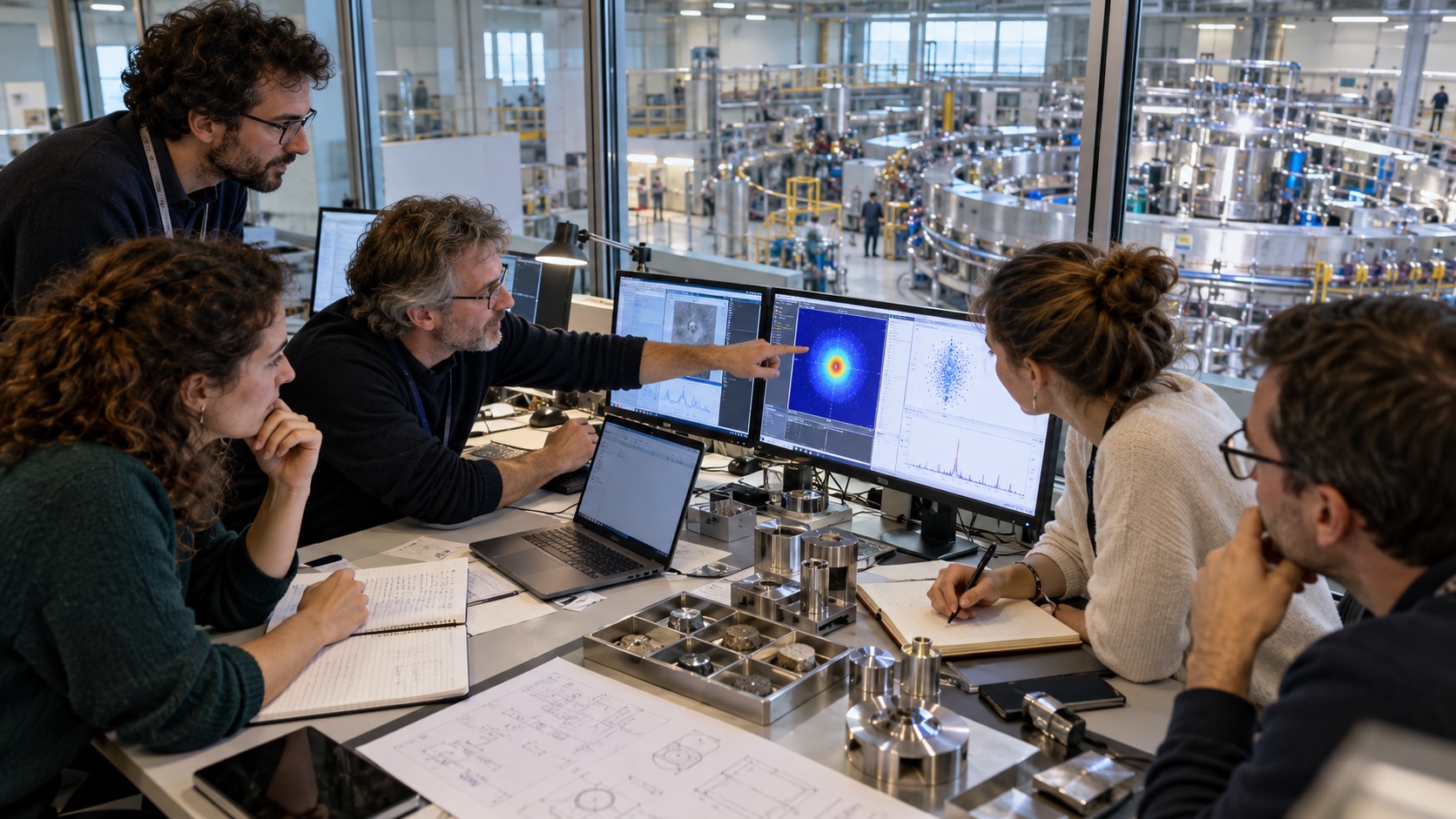
In January 2026, a European XFEL, DESY and University of Hamburg team reported the first net gain from hard X-rays circulating in a resonator cavity. Diamond mirrors repeatedly reflected a pulse through a 66-metre circuit so it met fresh electron bunches and became narrower, more stable and more coherent. The proof-of-concept does not mean a mature user service already exists: further strengthening, long-duration stability and preparation for broad access remain the next engineering work. But the long-considered XFELO principle was demonstrated in hardware.
Health, energy, materials and the limits of application claims
The value stretches across scientific fields. Ultrafast pulses can film chemical changes rather than infer only before and after states. Coherent X-rays can reconstruct nanoscale structures. Biomolecular experiments can reveal shapes and dynamics relevant to future medicines. Extreme-condition platforms test matter relevant to planets and fusion. Materials instruments examine magnetic, electronic and catalytic behaviour that can inform energy technology, data storage and electronics.
Research infrastructure does not convert automatically into a medicine, battery or climate solution. Most experiments answer a narrower question, improve a technique or falsify an idea; applications may take years and many institutions. European pride should rest on the capability to ask better questions and produce reproducible evidence, not on attaching every beam pulse to a promised product. The ESRF synchrotron, JET fusion programme and EMBL network offer the same lesson: shared instruments and data create a platform on which many discoveries can grow.
An engineering, data and computing ecosystem
The engineering ecosystem is itself an achievement. Laboratories and industry had to produce superconducting cavities, accelerator modules, magnets, precision mechanics, detectors, optics and control systems in series and then make them behave as one machine. This resembles ASML's European integration of extreme-ultraviolet lithography: leadership comes not from one magical component, but from coordinating specialist knowledge at tolerances no general-purpose supply chain can improvise.
European XFEL also depends on infrastructure beyond the experiment hall. Each pulse train can produce vast data streams that must be captured, calibrated, stored and analysed. That links photon science to software, detector development and high-performance computing. Europe's EuroHPC fleet addresses a related continental need: expensive instruments create public value only when researchers can turn their output into models, images and shared evidence.
Maintenance, cost and international dependence
Big science needs maintenance, not only inauguration. In 2025 the accelerator was warmed from its cryogenic operating temperature for the first time so mandatory helium-valve inspections, a new electron source, instrument work and preparations for future superconducting undulators could proceed. The facility had been completed on time and within budget in 2017, but keeping a frontier machine useful requires planned downtime, renewal, energy management and patient technical labour.
The annual operating budget is approximately €140 million. That is substantial public spending, and access cannot satisfy every worthy proposal. Energy, cryogenics, specialised staffing and equipment renewal carry environmental and fiscal costs. The responsible test is whether open scientific access, publications, training, industrial capability and discoveries justify those costs better than fragmented national duplication would. Europe's answer should be measured continuously, not assumed once because the machine is impressive.
International participation makes the achievement more European, not less. Switzerland and the United Kingdom remain scientific partners outside the EU; researchers worldwide can use the instruments; and the original financing included a large Russian share. Europe did not build scientific strength by pretending ideas or components stop at its borders. It built an institution capable of organising international contributions around European sites, standards, governance and long-term public purpose.
Big science as a federal European habit
The closest comparison is not a national laboratory enlarged, but a federation in miniature. Member countries pool resources; a common organisation runs shared infrastructure; expert review allocates scarce access; local teams support visiting users; and knowledge returns through publications, data, methods and trained scientists. CERN, ESO and European XFEL each show that scientific sovereignty means being able to host world-class collaboration, not excluding the world from it.
Europe can be proud that it transformed national accelerator expertise and political patience into a working instrument for the smallest and fastest processes in nature. The machine has moved beyond construction into hundreds of experiments, first-of-kind measurements and new laser physics. Its limitations are not a rebuttal: oversubscribed access, high operating cost, geopolitical strain and constant upgrades are the next tests of stewardship. The Proud Europe hub follows achievements like this because a democratic federal Europe needs citizens to see the capabilities they already own together—and the standards by which those capabilities should be kept worthy of trust.