Europe's giant microscope for matter
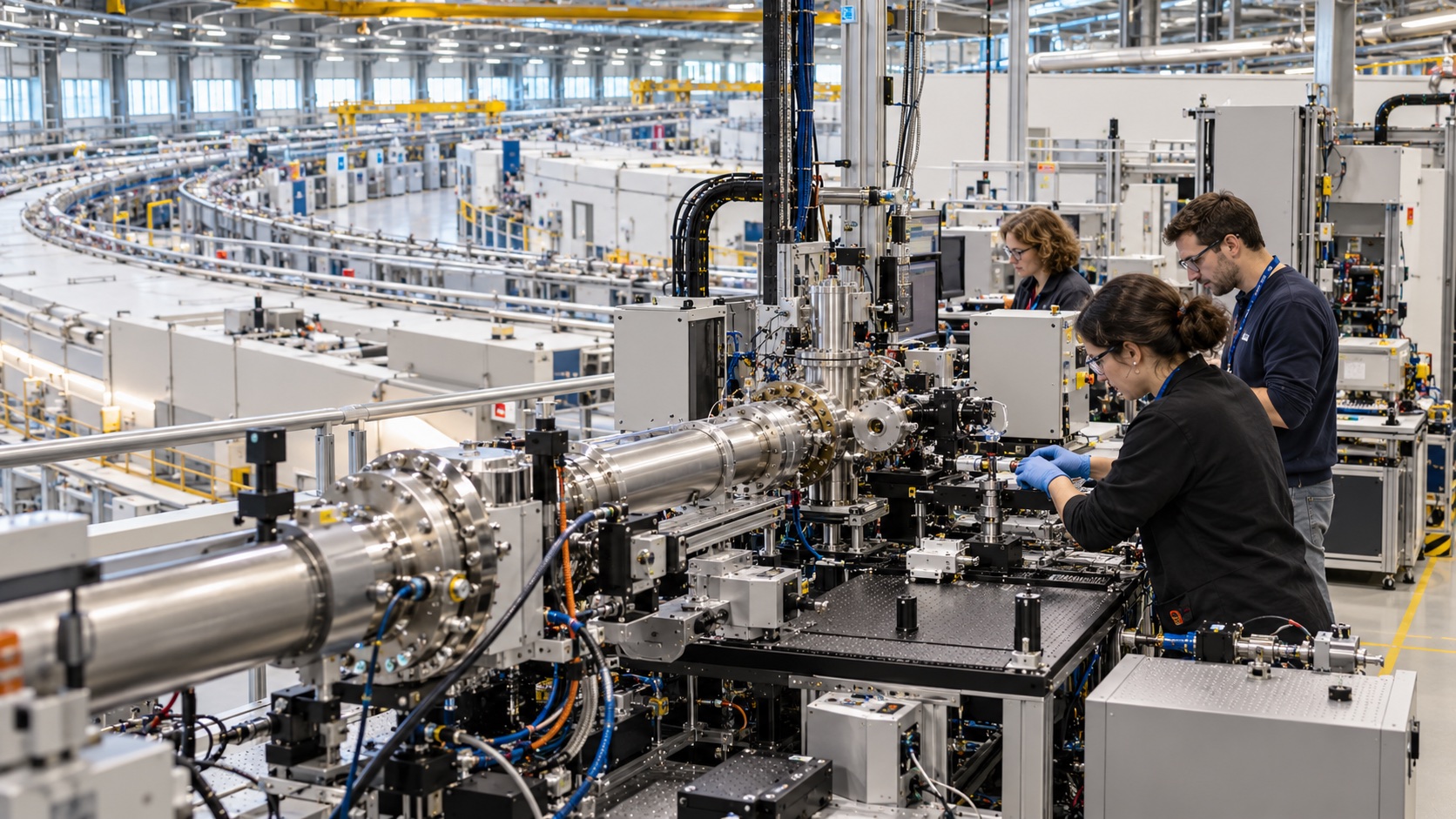
Europe built a microscope the size of a campus for questions that begin inside matter. The European Synchrotron Radiation Facility—ESRF—in Grenoble accelerates electrons around an 844-metre storage ring and directs the X-rays they generate into specialised experimental stations. Those beams let researchers map structures, chemical states, strain, motion and change across living tissue, batteries, catalysts, fossils, artworks, metals, ice and rock. One facility serves thousands of scientists because nineteen partner countries chose durable shared capacity over nineteen partial copies.
From a 1988 convention to user science
The achievement began before its present machine. European scientists proposed a common third-generation synchrotron in the 1970s; governments signed the ESRF convention in 1988; the first stored electron beam circulated in 1992; and user operations began in 1994 with fifteen beamlines. The original ESRF became the world's first third-generation synchrotron light source. It helped establish a model in which accelerator engineering, beamline instruments, visiting research teams and shared technical staff operate as one research service.
How a synchrotron and its beamlines work
A synchrotron is not an oversized hospital X-ray. Electrons are accelerated and kept on a curved path by magnets. When bending magnets or insertion devices alter that path, the electrons emit electromagnetic radiation. Beamlines select and shape parts of the spectrum, focus them on a sample and measure what is transmitted, scattered, diffracted, absorbed or emitted. Different instruments can reveal atomic arrangements, three-dimensional internal structures, chemical bonds, stress fields or processes changing over tiny fractions of a second.
The storage ring is the common engine; the beamlines are where questions become experiments. A structural biologist, battery engineer, palaeontologist and art conservator do not ask the same question or use the same detector. ESRF combines X-ray diffraction, spectroscopy, imaging, microscopy, scattering and structural-biology techniques so each community can work at the scale, energy and time resolution its samples require. Expert beamline scientists help turn a proposal into a safe and measurable experiment rather than merely renting out a bright beam.
The Extremely Brilliant Source upgrade
Europe renewed the engine with the Extremely Brilliant Source, or EBS. Engineers removed the old storage ring from the existing 844-metre tunnel, installed a new lattice and commissioned it for user operation on 25 August 2020. ESRF describes EBS as the first fourth-generation high-energy synchrotron. Its official history reports gains by a factor of 100 in brilliance and coherence for the upgraded source and a 30% reduction in electricity consumption compared with the previous machine. Exact improvement depends on the beam and metric, but the strategic result is clear: far more useful light from a reused continental asset.
That upgrade matters because brilliance and coherence change the questions that survive measurement. Smaller beams can target finer structures; coherent beams enable advanced imaging; increased flux can shorten measurements or make weak signals visible; and stable instruments can follow materials under realistic heat, pressure, load, reaction or electrochemical cycling. Better X-rays do not automatically create a discovery. They enlarge the experimental space in which a good scientific question can produce defensible evidence.
A research commons with scarce beamtime
The 2025 operating figures show a working research commons rather than an occasional showcase. ESRF recorded 2,392 public-beamtime proposals and accepted 1,018, or 43%. Users requested 32,578 eight-hour shifts and received 14,507; 16,760 shifts were delivered when commercial time was included. The facility recorded 10,432 total user visits in its reporting period and 1,532 peer-reviewed publications for 2025. Demand is a strength and a limit: even an exceptional continental instrument cannot schedule every worthy proposal.
Public access is allocated through peer review, technical feasibility and safety assessment. ESRF also has privately managed Collaborating Research Group access and paid commercial beamtime. Partner-country balance forms part of allocation because countries jointly finance the facility and expect scientific return. Researchers from outside the contracting parties can obtain access under defined conditions. This is not borderless access without governance; it is an organised bargain between excellence, fairness, safety, funding responsibility and scarce instrument time.
From proteins and batteries to heritage and Earth
The science reaches far beyond one discipline. Structural-biology beamlines reveal proteins and complexes that underpin disease mechanisms and drug research. Imaging can map tissues and organs across scales without slicing every structure apart. Materials experiments follow cracks, strain and phase changes inside working batteries. Spectroscopy identifies chemical states in catalysts or environmental samples. High-resolution scans can inspect fossils, manuscripts, paintings and archaeological objects while minimising destructive sampling. Earth scientists reproduce pressure and temperature conditions that help interpret processes deep inside the planet.
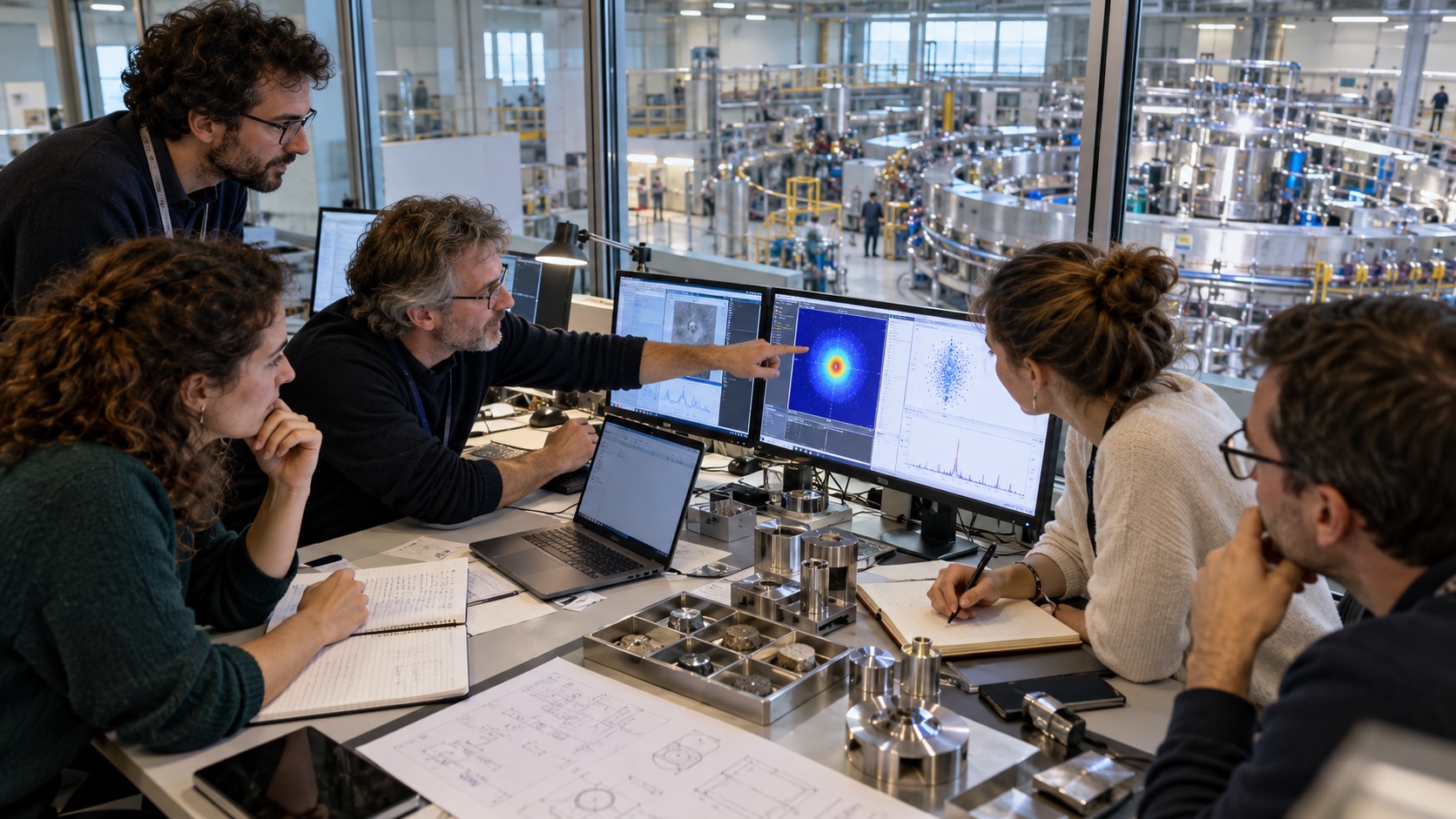
The 2025 highlights make those categories tangible without pretending every experiment is a finished product. ESRF teams reported three-dimensional mapping of stress and cracking in solid-state battery electrolytes, studies of protein and immune mechanisms relevant to infection and cancer, and high-resolution chemical analysis of rare-earth-element accumulation in deep-sea sediments. These measurements can guide later designs, therapies or environmental decisions, but a beamline result is evidence in a chain—not a battery factory, medicine approval or mining policy by itself.
A European campus of complementary instruments
ESRF also sits in a wider Grenoble ecosystem. The European Photon and Neutron Science Campus includes EMBL's Grenoble site, the Institut Laue-Langevin and the Institut de Biologie Structurale, enabling combinations of X-ray, neutron, electron-microscopy and biological methods. Europe gains more than a ring when shared institutions cluster: sample preparation, detectors, cryogenics, computing, training and specialist careers reinforce one another. The EMBL feature shows how a distributed life-science organisation complements this concentrated physical infrastructure.
ESRF and European XFEL should not be collapsed into one machine. Both produce powerful X-rays and both are shared European facilities, but their accelerator designs and experimental strengths differ. The European XFEL uses a linear accelerator to deliver ultrashort X-ray laser pulses in pulse trains, especially valuable for dynamics and single-shot experiments. ESRF stores electrons in a ring and serves many beamlines with exceptionally stable synchrotron radiation. Europe is stronger because researchers can choose complementary instruments instead of forcing every question into one flagship.
Governance, costs and access limits
Nor is ESRF an EU agency or a purely EU-funded programme. It is an international facility organised under a convention and supported by member and scientific-associate partners, including EU and non-EU countries. Its current website lists nineteen partner countries, grouped through thirteen members and six scientific associates. The facility also relies on international researchers, global suppliers, French local infrastructure and worldwide scientific exchange. Its European character lies in governance, sustained funding, common operation and shared access—not in claiming that every component or idea began inside the continent.
Big science has real costs. A storage ring and dozens of beamlines require continuous electricity, cooling, maintenance, magnets, vacuum systems, detectors, data storage, cybersecurity and rare technical skills. EBS reduced electricity use relative to the previous source, but a more capable facility still has an environmental footprint. Samples and users travel. Data volumes grow. Instrument upgrades compete with other research needs. Responsible pride measures efficiency, publishes performance, shares methods and keeps asking whether scarce beamtime is producing public value.
Access is also unequal before a proposal reaches the review panel. Experienced institutions know how to frame an experiment, prepare samples and fund the surrounding work. Smaller universities and countries can struggle to build pipelines that use the facility well. Training, remote access, collaborative proposals, transparent selection and support for new communities therefore matter as much as the nominal right to apply. A common machine becomes genuinely European when capability spreads back into laboratories, companies, hospitals, museums and classrooms across the partner network.
The federal lesson and the next test
The federal lesson is unusually concrete. Partner states did not surrender every national laboratory. They pooled the layer that benefits from scale: the accelerator, instruments, specialist staff, standards, proposal system and long-term upgrades. National teams kept their own questions and intellectual independence, then competed and cooperated for access to a common capability. That is subsidiarity with hardware—do together what is stronger together, and return the resulting knowledge to the places where scientists and citizens live.
Europe can be proud of ESRF because it kept renewing the institution after the opening ceremony. The first third-generation source became the first high-energy fourth-generation source; fifteen original beamlines became a portfolio of forty-six; and decades of engineering became a living service with more demand than capacity. The next tests are to widen access, keep the machine efficient, modernise instruments and data systems, train the people who understand them and show how excellent experiments become knowledge society can use. Shared European science is not an abstract slogan in Grenoble. It is electrons circulating day and night so that thousands of minds can see what none could see alone.