Europe made an international border feel ordinary
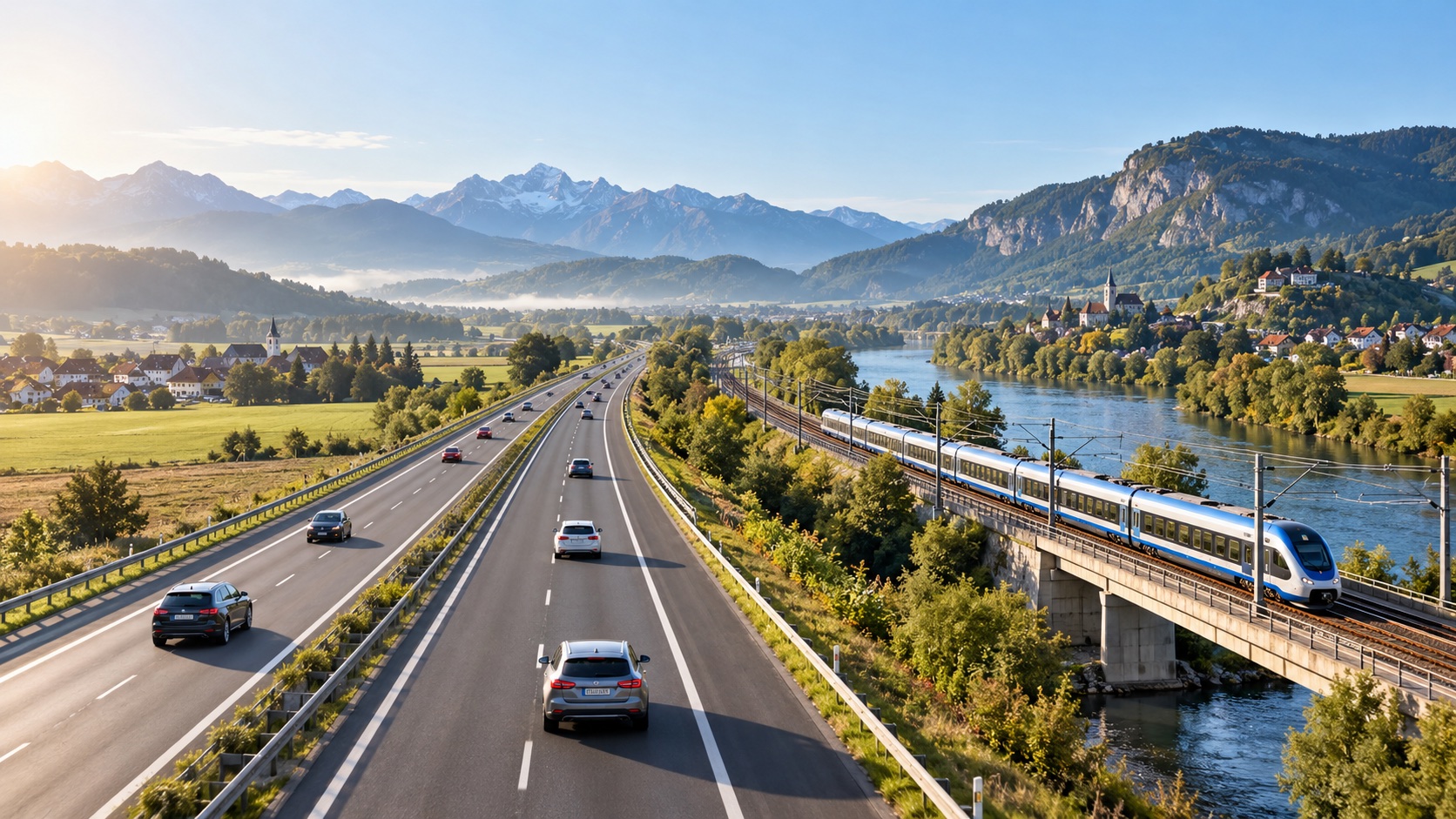
Europe built a place where crossing from one country to another can feel like crossing a region. A train can pass from Belgium into France, a commuter can drive from Slovakia into Austria, and a family can move between Spain and Portugal without stopping at a routine passport booth. That ordinariness is Schengen's greatest achievement: generations that once met guards, queues and barriers now experience much of the continent as one space.
Twenty-nine countries and more than 450 million people
The Schengen area contains 29 countries and more than 450 million people. Twenty-five are EU members; Iceland, Liechtenstein, Norway and Switzerland participate through wider-European association. Bulgaria and Romania became full members on 1 January 2025 when checks on persons at their internal land borders were removed. Cyprus participates in parts of Schengen cooperation but internal-border controls have not yet been lifted, and Ireland is not in the border-free area although it participates in selected security cooperation.
The scale is human before it is institutional. Official Council figures say around 3.5 million people cross internal Schengen borders every day for work, study, family or friendship, while almost 1.7 million live in one country and work in another. Europeans make an estimated 1.25 billion journeys inside the area each year. A border-free map becomes a labour market, a school run, a delivery route, a weekend and a relationship.
Schengen is not the same as free movement
Schengen is not the same thing as EU free movement. Free movement is a legal right that helps EU citizens live, work and study across the Union. Schengen removes routine checks on people at participating countries' internal borders and also benefits legally present non-EU nationals. Some EU countries are outside the border-free area, and four non-EU countries are inside it. The freedom-of-movement guide explains the citizenship right; Schengen is the operational geography that makes much of the journey feel domestic.
From five signatories to a continental system
The achievement began small. Belgium, France, Germany, Luxembourg and the Netherlands signed the Schengen Agreement in the Luxembourg village of the same name in 1985. The 1990 Convention added the legal and operational machinery, and controls were first abolished among seven countries in 1995. The Amsterdam Treaty then integrated the Schengen framework into EU law. Expansion followed because countries repeatedly judged shared rules and mutual evaluation worth the trust required to remove a national checkpoint.
That sequence matters. Europe did not simply lower barriers and hope. It built a rulebook for external borders, short-stay visas, police cooperation, judicial cooperation, information exchange, data protection and evaluation. A country joining the border-free area must apply the Schengen acquis, take responsibility for an external border on behalf of the others, connect to common systems and pass evaluations. The final decision to lift internal controls requires collective agreement.
What travellers and businesses experience
For travellers, the visible result is simple. Internal borders can normally be crossed at any point without a border check on people. Roads no longer need passport booths as a routine condition of passage, airports treat many Schengen flights like domestic journeys, and one short-stay Schengen visa can cover travel through the participating area. People should still carry valid travel and identity documents: airlines, police and other authorities can perform lawful checks that are not systematic border control, and national identification rules continue to apply. The EU cash-declaration guide explains another important distinction: border-free travel does not remove the harmonised declaration duty when a traveller enters or leaves the EU carrying €10,000 or more in cash.
For business, removing border queues is infrastructure. The Council reported intra-EU trade above €4.1 trillion in 2024 and describes Schengen as serving 32 million European businesses. A manufacturer can plan a truck route, a service company can reach clients, a hospital can recruit across a neighbouring border and a tourist can build one itinerary across several countries without multiplying border formalities. The benefit is not abstract efficiency; it is fewer dead hours and a larger practical market.
External borders and shared information systems
Open internal borders depend on cooperation elsewhere. Schengen countries apply common rules at the external border and a common short-stay visa policy. Checks at an external entry point are performed on behalf of every participating country. The Entry-Exit System became fully operational in April 2026 for covered non-EU short-stay travellers, replacing passport stamping with a digital record of entries, exits and biometric data. That system does not apply to EU free-movement travellers in the same way and should not be confused with the separate ETIAS travel-authorisation system.
Security cooperation is another load-bearing wall. The Schengen Information System allows authorised border, police, customs, visa and judicial authorities to act on shared alerts about wanted or missing people, vulnerable people, entry or stay decisions, stolen or misused documents, vehicles, firearms and other objects. The country entering an alert owns and maintains it; the system tells an officer why the person or object is sought and what action to take.
Security cooperation needs rights and oversight
Information sharing is powerful and therefore demands restraint. A shared alert can help find a missing child, arrest a person sought under a European Arrest Warrant or seize a stolen vehicle across a border. Incorrect or outdated data can also harm an innocent person. Schengen rules sit beside data-protection rights, purpose limits, supervision and procedures for access, correction and deletion. A border-free Europe should never mean an accountability-free database.

Police cooperation also reaches beyond databases. Schengen provides frameworks for direct information exchange, cross-border surveillance, hot pursuit and joint operational assistance under defined conditions. National police forces remain national, and powers, safeguards and judicial oversight still matter. The European achievement is not one central police body; it is a legal and operational bridge that lets authorities cooperate when a crime, suspect or missing person crosses a line on the map.
Temporary controls are the stress test
Temporary internal border controls are the clearest stress test. The Schengen Borders Code permits a country to reintroduce controls when a serious threat to public policy or internal security makes them necessary. The 2024 reform reinforces that they must be a last resort, proportionate, time-limited and accompanied by measures that reduce harm to travellers and cross-border regions. It also promotes alternatives such as risk-based police checks and stronger bilateral cooperation.
The safeguard is real and so is the present tension. On 4 October 2026, the Commission's public notification list showed temporary controls affecting several Schengen countries, including Austria, Denmark, France, Germany, Italy, Norway, Poland, Spain and Sweden. Some controls cover only particular borders or transport modes; some are extended for months. Their existence does not erase Schengen, but repeated or broad controls can weaken the predictability on which commuters, families and supply chains rely.
Europe should judge those measures honestly. Serious terrorism, organised crime, hybrid threats, public-health emergencies and exceptional migration pressure can require action. Yet a national border booth is not a substitute for effective external-border management, asylum decisions, returns, intelligence, policing or solidarity. The legal last-resort test matters precisely because governments can find visible border controls politically easier than solving the underlying shared problem.
Common borders require common accountability
External borders carry an equally serious responsibility. Every country with a Schengen external frontier acts for the whole area, but it also acts under EU law and fundamental-rights obligations. The 2026 State of Schengen report recorded progress in digital systems, surveillance and operational support while identifying uneven staffing, equipment, database use and preparedness. Strong common borders mean competent, lawful and accountable administration—not spectacle and not the abandonment of protection obligations.
Schengen governance turns mutual trust into a maintenance programme. Countries undergo evaluations, deficiencies produce remedial work, the Commission reports annually on the state of the area, and ministers coordinate through the Schengen Council and cycle. Cyprus' readiness is assessed before internal controls can be lifted. This can look procedural, but the alternative is trust by assertion. A shared area survives because partners can inspect whether the common rules work in practice.
A European public good beyond EU membership
The project also proves that Europe can include non-EU partners without blurring institutional facts. Iceland, Liechtenstein, Norway and Switzerland apply the border, visa and cooperation rules through association. They participate in the shared space without being EU members or gaining the same role in EU lawmaking as member states. That asymmetry is a limitation, but it also shows that European public goods can extend beyond the Union when obligations, evaluations and operational participation are real.
Why Schengen is a Proud Europe achievement
Schengen belongs beside ERTMS, 112, the interconnected electricity system and roaming. Each takes a border that once fractured daily life and replaces it with common rules, interoperable systems and shared responsibility. None abolishes countries; each makes the continent work more like one civic and economic space.
The next test is not whether Europe should retreat to twenty-nine isolated border systems. It is whether Schengen can preserve free movement while improving external-border quality, lawful migration management, police cooperation, data accuracy, democratic scrutiny and solidarity with the places carrying the greatest operational burden. The 2026 report's gaps are a work programme for stronger European capacity, not an argument against the freedom already built.
Europe can be proud of Schengen because it changed the physical experience of the continent. Five countries began an experiment in 1985; forty years later, routine internal border checks had disappeared across 29 countries. The achievement is not perfect or automatic, but it is enormous. The Proud Europe hub is about exactly this kind of capability: sovereign countries building a shared public system so useful that millions experience it as normal.